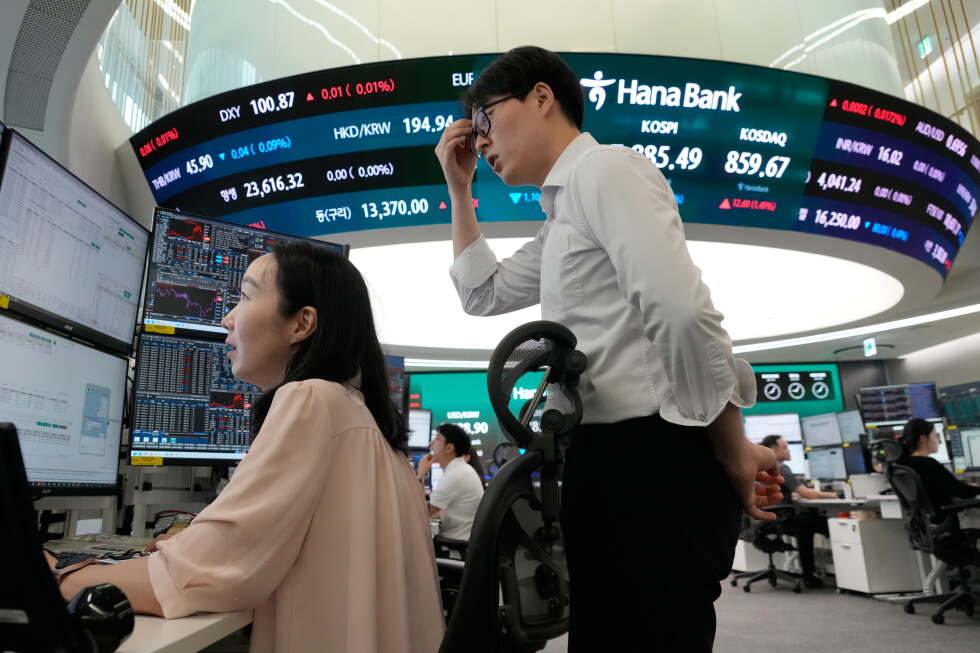
Asian shares fell Tuesday, with South Korea's Kospi dropping nearly 5%, despite a rebound for AI stocks that lifted benchmarks on Wall Street. This was reported by Qazaqyia.kz citing Associated Press.
In Seoul, the Kospi dropped as much as 8% but recovered some losses to close 4.9% lower at 7,656.31. Shares in computer chipmaker Samsung Electronics slumped 7.7% even after it announced its operating income surged 19-fold to 89.4 trillion won ($58.7 billion) in the last quarter while its revenue more than doubled. SK Hynix shares also fell 5.2%.
Japan's Nikkei 225 index fell 2.5% to 39,200.45. Hong Kong's Hang Seng index dropped 1.8%, and the Shanghai composite index lost 0.6%. Australia's S&P/ASX 200 fell 1.4% to 7,800.50.
Oil prices rose: Brent crude futures gained 0.5% to $86.50 a barrel, while U.S. West Texas Intermediate crude rose 0.4% to $82.90. U.S. futures were mixed: Dow Jones Industrial Average futures fell 0.1%, while S&P 500 futures rose 0.2%.
On Wall Street Monday, the S&P 500 rose 0.3% to 5,600.12, nearing a new record. The gain was driven by strong AI stocks, with Nvidia shares surging 4.5%. The Nasdaq composite rose 0.8% to 18,200.45, while the Dow Jones fell 0.1% to 39,100.23.
U.S. President Donald Trump rang the opening bell at the New York Stock Exchange on Monday, expressing confidence in the markets. He noted that the growth of AI and the tech sector is crucial for the U.S. economy.
Investors are monitoring escalating tensions between Iran and Israel, which could impact oil prices. Analysts warn that geopolitical risks may increase market volatility.
The decline in South Korea's Kospi was driven by domestic political uncertainty and selling pressure in the tech sector. Despite Samsung Electronics' strong earnings report, investors are concerned about intensifying competition in the semiconductor market.
In Japan, the Nikkei's decline was linked to a strengthening yen, which pressured export-oriented stocks. The drops in Hong Kong and Shanghai were fueled by worries over China's economic slowdown.
Despite the retreat in Asian markets, the rise in AI stocks is maintaining optimism on Wall Street. Analysts believe that increased investment in AI technologies could drive further market gains.
The rise in oil prices is tied to Iran-Israel tensions, which threaten Middle East supplies. Brent crude reached $86.50, its highest level in several weeks.
The mixed performance of U.S. futures reflects investor anticipation of the Federal Reserve's decision on interest rates. Markets expect the Fed may ease monetary policy.
In conclusion, despite the decline in Asian markets, the growth of AI stocks is positively impacting global markets. Investors are closely watching geopolitical events and economic indicators.