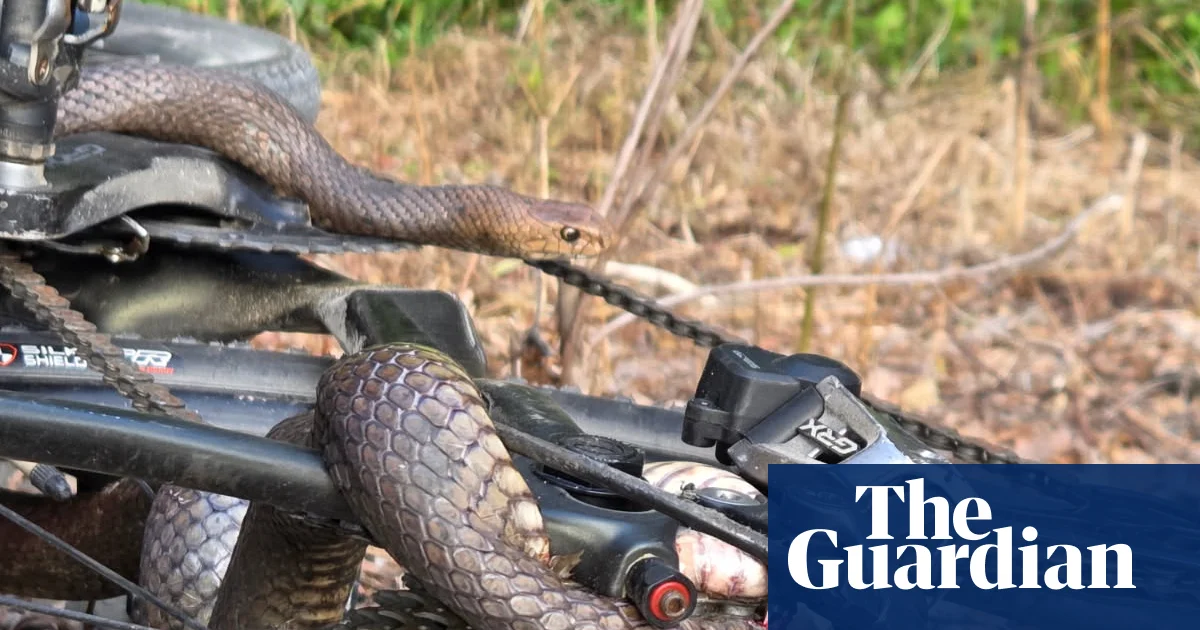
A woman in her 60s is recovering after being bitten by a two-metre-long eastern brown snake that had become entangled in her bike chain in regional Australia. This was reported by Qazaqyia.kz citing The Guardian.
She was riding on the northern rivers rail trail near Burringbar, in the Tweed shire in northern New South Wales, when she ran over the snake.
Paramedics were called to the incident at about 1pm on Wednesday to help the woman, who had been bitten on the thigh, a NSW ambulance spokesperson said. She was taken to Tweed Valley hospital in a stable condition. According to the Northern NSW local health district, she was discharged on Thursday morning.
Eastern brown snakes are highly venomous and have been dubbed the world's second most venomous snake. They are generally a medium-sized species found across eastern Australia in a wide stretch from northern Queensland to South Australia. Although brown snakes are the most common cause of fatal snake bites in the country, deaths by bites from any species of snake are rare.
The snake catcher Sarah Mailey, who was called to the scene, said freeing the snake from the bike chain was highly challenging because its upper body remained completely free.
"Its head wasn't in the chain so it was free to be able to strike her leg," she said.
Mailey said the rider had sustained a "dry bite", meaning the venom did not enter the woman's bloodstream.
Mailey was eventually able to pin the snake's head while bystanders assisted in disentangling the chain. Police also attended the scene at the request of paramedics to ensure public safety in the area.
The snake was euthanised due to injuries sustained in the ordeal, Mailey said.
Mailey, who has been called out to remove a number of snakes along the rail trail, said the reptiles are often attracted to the underside of the concrete path for the "little burrows and rodents that dig underneath it".
"In April, snakes start to look for where they're going to spend their time and they move under there," she said.
"Given that he was probably just sitting there not moving, it wouldn't have been something that she [the bike rider] would have spotted."
The snake was also blind in its left eye, which likely contributed to the situation, she said.
"She [the bike rider] probably just thought it was a stick or a shadow and given that the snake's blind in that eye, it's obviously not seen the shadow coming towards it and given it enough time to move."
The cooler weather also played a role in slowing the snake's reflexes.
"If it was any other time of year and the snake wasn't blind, it would have had energy and seen her coming and got out of the way.
"So it's just a mixture of the time of the year, it being a blind snake, and it's just part of life, unfortunately."
While an incredibly rare mishap, Mailey discovered it was not entirely unprecedented.
"When it did happen, I actually rang one of my close friends that's a snake catcher. He's been doing it for 31 years and I explained what had happened to him and he said, 'I've had this happen a couple of times.'"
Mailey said eastern brown snakes are frequently mistaken by locals and holidaymakers, often confused with entirely harmless species based on colour.
"They often get misidentified with what would be a keelback snake, which is a totally harmless, non-venomous snake," she said.
"People mix up brown snakes, eastern brown, or even king brown … we also have your brown tree snake."
Mailey said she frequently receives calls from holidaymakers who mistake harmless species for dangerous ones based on appearance.
"I get a lot of calls … thinking they've got an eastern brown in the house at night-time … we'll find it's just a brown tree snake because they've based it on colour.
"I've caught every colour brown snake, I've caught a really red-coloured one, a silver one, [and] a jet black one that I could have mistook myself for a red [bellied black snake].
"[Eastern brown snakes] definitely do come in all colours."
For cyclists and bushwalkers encountering a snake on the trail, Mailey urged patience and caution.
"If you can see it from afar, stop and just wait for it to move off the path," she said. "If it's not moving off the path because it's sunbaking and can't see you, pop off your bike and try to walk the furthest way around it you possibly can."