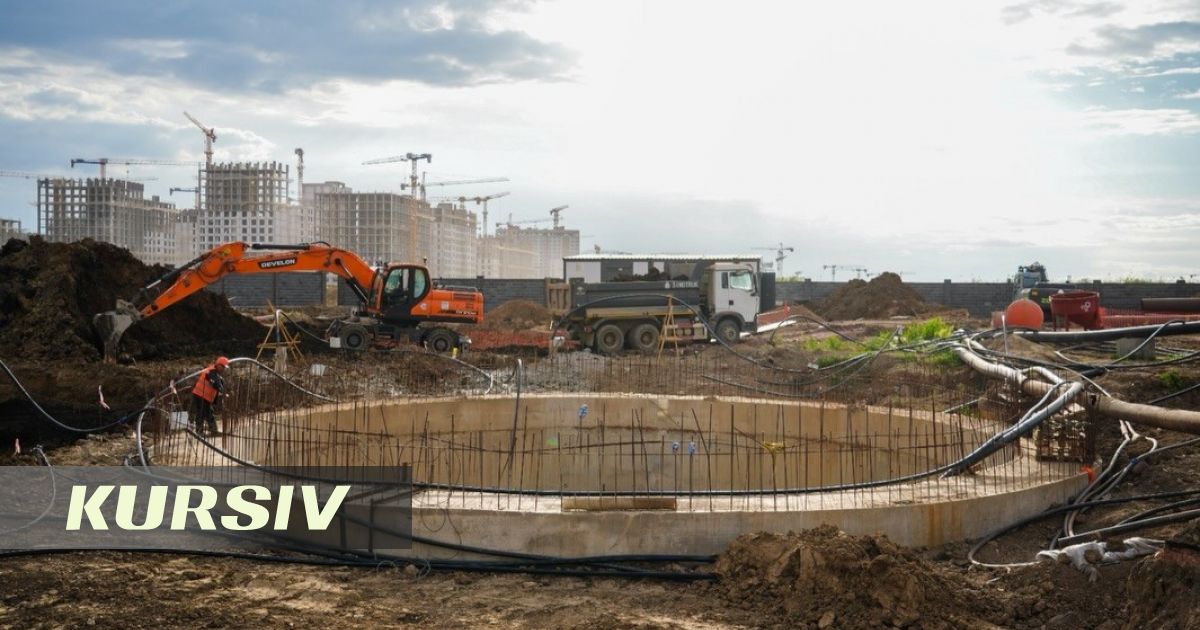
Astana is preparing for an increase in water consumption by building new main networks and expanding water supply capacities. This was announced by the city's akim, Zhenis Kassymbek, on Instagram. This was reported by Qazaqyia.kz citing Kursiv Media.
According to him, in the coming years, about 20 specialized projects are planned to be implemented in Astana, including the construction of new water pipelines, sewerage and stormwater networks.
As Kassymbek noted, to prevent a shortage of drinking water, construction of a technical water pipeline began last year. It will allow supplying up to 50,000 cubic meters of raw water per day to water treatment plants.
In 2025, 3.2 km of pipeline were laid, and in the first five months of 2026, another 5.8 km were laid. Earlier, in 2023, the third pumping and filtration station (NFS-3) was commissioned in the city.
"In the coming years, it is necessary to implement about 20 projects for the construction of main water supply networks. This will ensure reliable and uninterrupted water supply, taking into account the further development of the capital and growth in consumption," the akim noted.
Last year, two projects were completed in Astana: 10 km of domestic sewerage networks and one sewage pumping station were built.
This year, according to the akim, it is planned to complete two more projects — the construction of two sewage pumping stations.
Currently, the average daily volume of wastewater disposal in the capital is 350–360 thousand cubic meters per day, with an annual increase of about 10 thousand cubic meters.
Wastewater treatment is carried out at existing sewage treatment plants.
"To increase capacity, construction of KOS-2 with a capacity of 188 thousand cubic meters per day will begin this year. The design of local treatment facilities in the Koktal, Ondiris residential areas and the Industrial Park with a total capacity of 85 thousand cubic meters per day is also ongoing. At the same time, modernization of KOS-1 is underway with an increase in capacity by 25 thousand cubic meters per day," the akim noted.
Zhenis Kassymbek also reminded that the capital's stormwater drainage system includes 20 treatment facilities, one storage pond and 621 km of main collectors. It ensures the removal of surface runoff from an area of more than 20.1 thousand hectares.
In recent years, more than 22 km of networks, 9 pumping stations and 6 treatment facilities have been built and reconstructed. In 2025, work was completed on five facilities, including sections north of the Korgalzhyn highway, collector No. 2 to OS III-6 (Ilyinka residential area) and OS of district II-4 (Mynzhildyk). As a result, the coverage area increased from 16.7 thousand to 20.1 thousand hectares.
In 2026, construction and expansion of two treatment facilities continues — in the Triathlon Park area and on Akzhol Street.
The implementation of these projects will reduce the risks of flooding in a number of streets and roads in the Almaty and Baikonyr districts, the akim said.
Earlier, Zhenis Kassymbek told subscribers that the capital had begun preparing for the heating season.
And the day before, Kursiv wrote that the second water supply line of Astana is planned to be completed by 2028.