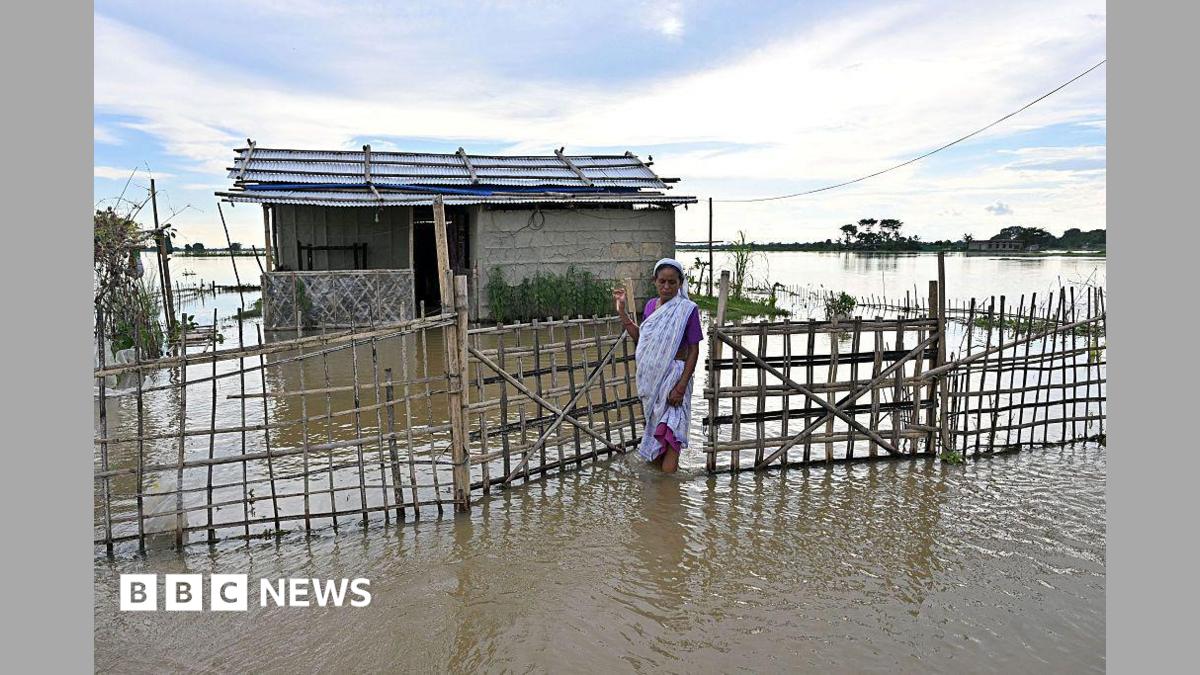
During floods in India's Assam state, a 97-year-old woman was carried to safety on a raft made of banana trunks. This was reported by Qazaqyia.kz citing BBC News.
Well past midnight on 19 July, as floodwaters surged through the village of Charing in Assam's Sivasagar district, Bornali Baruah and her husband were trying to save his 97-year-old mother. Lokada Duarah, almost bedridden, could not walk. With no boat or rescue team available, they lifted her onto a makeshift raft made of banana trunks and carried her through the rushing water towards safety.
"Everyone was trying to save themselves," Baruah says. An hour later, the three reached a shelter camp on a national highway some distance away. The water was three to four feet deep, and the current so strong that they had to move slowly, holding each other's hands and using sticks to steady themselves. By then, Baruah's home was disappearing beneath the flood, with water eventually rising to about five feet inside.
The scene in Charing was part of a wider disaster across Assam. The latest figures put the death toll from floods at 100, with 10 districts and 456 villages affected and about 140,000 people impacted. Fifty-two relief camps have been set up. Overall, the floods have affected nearly 1.2 million people across 25 districts, damaged more than 19,000 houses and left more than 75,000 people in 252 relief camps.
The floods have been particularly severe in parts of Upper Assam, where villages like Charing that do not usually flood have been inundated. For Baruah, 40, the shock is especially profound. "This is the first flood we have experienced in this area in our lifetime," she says.
Baruah has lived in Charing since birth, and her ancestors lived here before her. She recalls hearing about a major flood in 1950, but nothing like this had happened during her lifetime. Her home sits in a landscape criss-crossed by rivers, though none runs immediately beside it. The single-storey, eight-room house is about 25km from Sivasagar town; the Brahmaputra is roughly 20km away, the Dikhow 12km, the Jhanji 10km and the Mitong just 5km.
She had never imagined the water would reach her doorstep. But when it did, the flood threatened not only her home, but the livelihood she had spent years building. Baruah was once a full-time journalist. In 2016, she left the profession to take up animal husbandry, and three years later was named Assam's 'Best Livestock Farmer'. Her farm grew to around 300 goats, 500 ducks and 1,000 chickens, along with fish. The flood destroyed much of it. She lost most of her goats, 300 ducks, 300 chickens and a sizeable amount of fish, as well as the machine she used to make animal feed. Furniture, laptops, vehicles and the family's collection of books were also destroyed. None of her livestock was insured. "There is no insurance system here for livestock, especially goats," she says.
The first warning came on 17 July, when the Jhanji river began to rise. Two days later, the Dikhow and Mitong spilled into surrounding areas as the Brahmaputra and its tributaries swelled rapidly. Several rivers breached their embankments, sending powerful currents through towns and villages. About a day after the water began rising, she and her family abandoned their home. By then, the water inside the house was four feet deep. They spent the next 10 days in a relief camp.
For five days in the camp there was no electricity or mobile connectivity, and Baruah could not even charge her phone. The government provided the family with a relief kit containing rice, lentils and cooking oil. Help also came from strangers at the camp. A young woman whom Bornali had never met helped with food, cleaning and looking after her 60 surviving goats. Another took responsibility for treating and feeding animals that had fallen ill.
But why did the water reach a place that Baruah says had never flooded before? Dhrubajyoti Sahariah, a professor of geography and director of the Centre for Brahmaputra Studies at Gauhati University, says flooding itself is natural in the Brahmaputra Valley. What has changed is the "frequency, intensity and severity of floods well beyond historical norms".