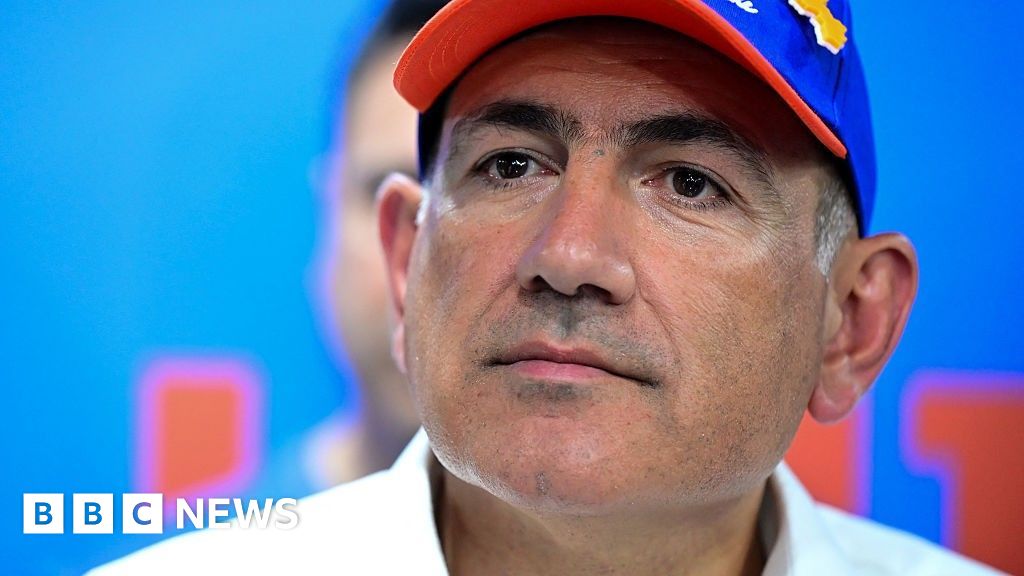
Prime Minister Nikol Pashinyan's party won the decisive election, which was meant to determine whether the country would continue moving toward the West. This was reported by Qazaqyia.kz citing BBC News.
Pashinyan's centrist party "Civil Contract" won 49.8% of the vote, the "Strong Armenia" alliance came second with 23.2%, and the "Armenia" alliance third with 9.9%.
Sunday's vote was the first general election since Armenia suffered a crushing military defeat by Azerbaijan in 2023. It was seen as a test of the prime minister's drive to deepen ties with the West amid growing economic pressure from Russia, its largest trading partner and traditional ally.
Pashinyan, in power since 2018, declared victory on Monday after preliminary results showed his party had won more than 50% of the vote. "The Armenian people voted for peace, regional prosperity and cooperation," he said.
The election drew significant international attention. On Monday, France and the EU congratulated Pashinyan, praising Armenia's rapprochement with the West. Russian Foreign Ministry spokeswoman Maria Zakharova, as reported by TASS, said there was "unprecedented pressure" on opposition parties and alleged "interference" by the West. Zakharova also noted that the election showed "extreme polarization" of Armenian society.
The success of "Civil Contract" came amid a decline in Pashinyan's domestic support from 54% in 2021 to about 30% today. Nineteen parties and alliances took part in the election, but only a few won enough votes to gain seats in the National Assembly. Turnout was 59%, the election commission said.
The conservative party "Prosperous Armenia" came fourth with 4% of the vote. It, like the "Strong Armenia" alliance and the "Armenia" alliance, are pro-Russian. Pashinyan also said on Monday: "We will continue the course of rapprochement with the West, but we will also continue our participation and membership in the Eurasian Economic Union."
In late May, Russian President called on Armenia to hold a referendum "as soon as possible" on joining the EU or maintaining membership in the Russia-led Eurasian Economic Union (EAEU). Last month, Putin listed the economic benefits Armenia could lose if it moves closer to the West. Russia supplies gas to Armenia at $177.50 per 1,000 cubic meters, while European market prices exceed $600. Two weeks before the election, Moscow banned exports of Armenian flowers, mineral water, cognac, fresh vegetables and fruits.
Pashinyan's efforts to distance from Moscow include adopting a law to begin the process of joining the EU and accelerating the peace process with neighboring Azerbaijan mediated by the US. The latter earned him support from US President Donald Trump. He also hosted a major summit of EU leaders and Ukrainian President Volodymyr Zelensky in Yerevan this year.
Pashinyan's drop in popularity is mainly due to the conflict over Nagorno-Karabakh. His critics have never forgiven him for concessions for peace with Azerbaijan. The peace deal also remains deeply controversial: according to a recent poll, 44% support it, while 41% oppose it.
In Yerevan, the election results did not cause much excitement. 70-year-old gardener Lala said she voted for Pashinyan: "I am excited. He is leading us to peace, he raised pensions, we have free healthcare, we see what he is doing, we are not voting for him blindly." 40-year-old Gohar expressed skepticism about Armenia's possible future in the EU: "I have no evidence that the European Union is waiting for Armenia. We know that Georgia has been waiting a long time, Turkey has been waiting a long time." Asked about Pashinyan's peace agenda, she said: "Yes, of course, there is peace in Nagorno-Karabakh now, but no Armenians are left there, I don't want the same to happen here."