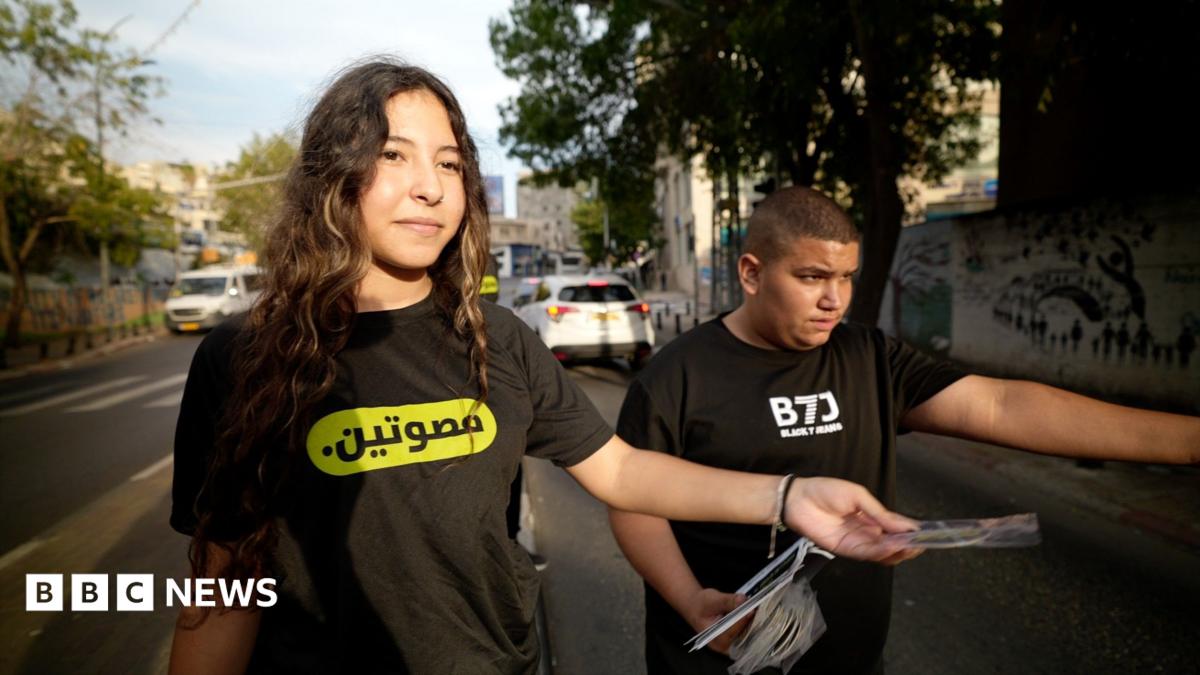
In Nazareth, Israel's largest Arab-majority city, students are handing out leaflets by the roadside urging motorists to vote in next week's closely fought general election. Polls indicate that Arab parties could be left holding a critical balance of power. This was reported by Qazaqyia.kz citing BBC News.
Arab Israelis account for about a fifth of the population and often describe themselves as Palestinian citizens of Israel. Disaffection has often driven down past turnout among Arab Israelis. But this election, there is a strong push to get rid of the most right-wing governing coalition in the country's history — an alliance between veteran Prime Minister Benjamin Netanyahu and far-right and ultra-Orthodox parties.
"I see it as our duty to bring down this extremist government. They treat us as second-class," says Arkan Badran, 23, who is with the students giving out flyers. "I call on all young men and women to vote for Arab lists, which represent us, because this is our future."
Most opinion polls indicate that neither Netanyahu and his partners nor the main "Change Bloc", led by centre-right former military chief Gadi Eisenkot, has a clear path to a parliamentary majority. If they are right, after the election anti-Netanyahu parties wanting to form a governing coalition would either have to go back on pledges not to work with the prime minister or make a deal with Arab-majority lists.
A major sticking point is that Eisenkot has so far ruled out forming a government with Arab parties, citing a lack of shared values.
Israel's politics and society have been changed by the deadly, unprecedented Hamas-led assault on the country on 7 October 2023, and subsequent war in Gaza. There is increased mistrust of and hostility towards the country's Arab minority.
"After October 7, we were treated as enemies of this country," says Suha Salman Mousa of the Mossawa Centre in Nazareth, which advocates for equal rights for Arab citizens. "There was shrinking space for freedom of speech. There were major arrests, there was also firing of people from their workplaces because they put something on social media or they went out against the war on Gaza."
Salman Mousa accuses ministers of "systematic discrimination and incitement" against Arab Israelis. Civil society groups say they have disproportionately cut budgets for Arab communities. The government says reductions are needed to fund wartime defence and security spending.
There have also been politicised campaigns against Arab physicians working in Israeli hospitals and racially motivated attacks on Arab bus drivers by Jewish Israelis.
Some electioneering has sought to capitalise by deepening social divisions. The far-right Finance Minister, Bezalel Smotrich, has vowed to "Judaise" parts of the northern Galilee and southern Negev regions where most Arabs live, likening this to expanding settlements in the occupied West Bank.
The majority of Arab Israelis are descendants of Palestinians who remained within what became Israel during the war that surrounded the creation of the state in 1948, when hundreds of thousands were forced from or fled their homes. Israel's current government often frames them as a threat to the state's Jewish identity. Recently, the prime minister has claimed that his rivals plan to team up with Arabs and form a "dangerous government".
To make this point, his campaign has put up billboards, including one at a road junction at the main entrance to Nazareth. They suggest a choice between: "Right or Palestine" — with pictures of main opposition figures, including right-wingers, depicted as representing the latter not the former. The Netanyahu campaign has also used AI-generated videos to present his opponents embracing Arab leaders.
At Radio Nas, a popular Arabic-language station in Nazareth, I meet news anchor Mohammed Magadli, who is also an analyst for Israel's Channel 12. His father, Raleb Magadli, served as Israel's first Muslim minister between 2007 and 2009, representing the Labour party.
I ask the younger Magadli what he makes of Change Bloc leaders refusing to join forces with Arab parties. "In a word its racism. But if we're trying to explain why, it's because of the political interests of Benjamin Netanyahu," he says. "He's trying all the time to pull the legitimacy of the Arab parties - because they're Arab, because they're Palestinian. This is affecting the majority of the Jewish parties in Israel."
Polls this week have suggested that both Eisenkot's bloc and Netanyahu's religious-nationalist bloc could each win around 50 seats of the 120 in Israel's parliament while 13 or 14 seats in total could go to Arab-majority groupings. These are the Joint Arab List, a coalition of Hadash, Balad and Taal, and the smaller United Arab List, an Islamist party headed by politician Mansour Abbas.
While Abbas's party was originally created as part of the Islamic Movement in Israel — which has socially conservative values — he has become known for joining with Jewish partners. He prioritises solving the problems of Arab Israelis and speaks relatively little of Palestinians in the West Bank and Gaza.
Abbas has had a taste of power. In 2021, he became a minister in a previous, short-lived Israeli government led by Naftali Bennett — now a right-wing member of Eisenkot's bloc. For this election, he has taken the surprise step of giving the number two position on his slate to a Jewish former police officer.