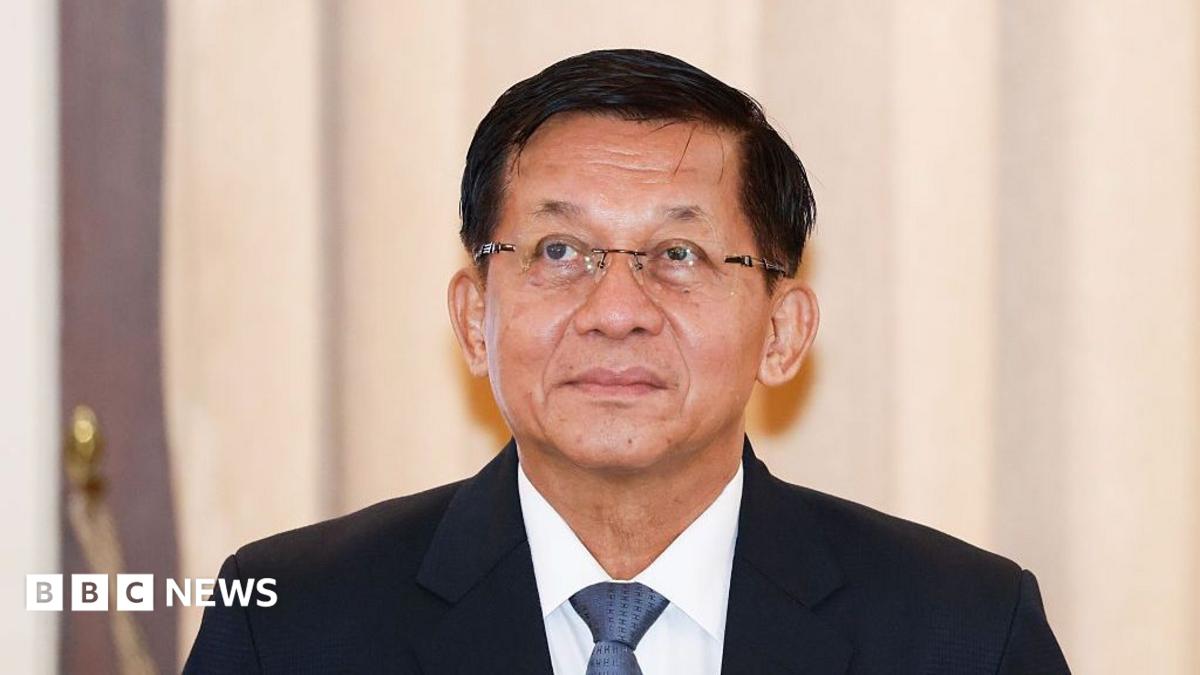
Has Washington's long-standing policy of isolating the military regime in Myanmar now changed? The revelation that a top official in the Trump administration met its leader Min Aung Hlaing last month, and the removal of some business figures from the US sanctions list, suggests that it has. This was reported by Qazaqyia.kz citing BBC News.
Until now, the US had had very little official contact with the regime following the 2021 coup, when Myanmar's military ousted democratically-elected leader Aung San Suu Kyi. The meeting on 15 and 16 September was with US Assistant Secretary of State for Intelligence and Research Michael Vance, and it took place in Myanmar's capital Nay Pyi Taw. Its ostensible focus was to secure the release of Adam Castillo, a US citizen who had been detained in June over a dispute with the local American Chamber of Commerce. Vance was the most senior US official to meet Min Aung Hlaing since he seized power.
Signs of a shift in US policy towards Myanmar go back to July last year, at the height of President Donald Trump's tariff war. That was when Min Aung Hlaing received a personal letter from the US president informing him that his country's shattered economy was about to be hit by 40% tariffs. He replied immediately to express his "sincere appreciation for this encouraging invitation to continue participating in the extraordinary Economy of the United States, the Number One Market in the World," mimicking Trump's hyperbolic phrasing. There was no mention in Trump's letter of the appalling human cost of Min Aung Hlaing's power seizure; of a democracy crushed and leader Aung San Suu Kyi jailed.
That same month the regime signed a $3m contract with DCI, a long-standing Washington lobbying firm. Since then the military government has also hired Roger Stone, a controversial lobbyist and confidant of President Trump, at a fee of $50,000 a month. Also around the same time Adam Castillo, a former US marine and Trump supporter, was in Washington trying to persuade Vice President JD Vance's team that it was time to re-engage. Castillo believed that the US reliance on sanctions to isolate the junta had failed.
The US dependence on rare earths from China had been exposed when China blocked them in retaliation against Trump's tariffs in April. The administration began prioritising finding alternative sources. Myanmar happens to have large reserves of rare earths which are currently being exploited solely for China's use. At almost exactly the same time, the state department issued new guidance to US embassies around the world on what to say about elections: "messages should avoid opining on the fairness or integrity of an electoral process, its legitimacy, or the democratic values of the country in question". So, when Myanmar held its much-criticised general election in December and January, the US did not, like most Western governments, condemn it as neither free nor fair.
Washington's decision to lift sanctions on some of those targeted by the Biden administration seemed only to confirm the new direction of US-Myanmar policy. "For years, the US approach to Myanmar has been defined by isolation, sanctions, and distance," wrote the lobbyists DCI in a recent newsletter. "That era is over… thankfully, President Trump has the courage to try something different." The tone is certainly different, but not so much the substance of US-Myanmar relations.