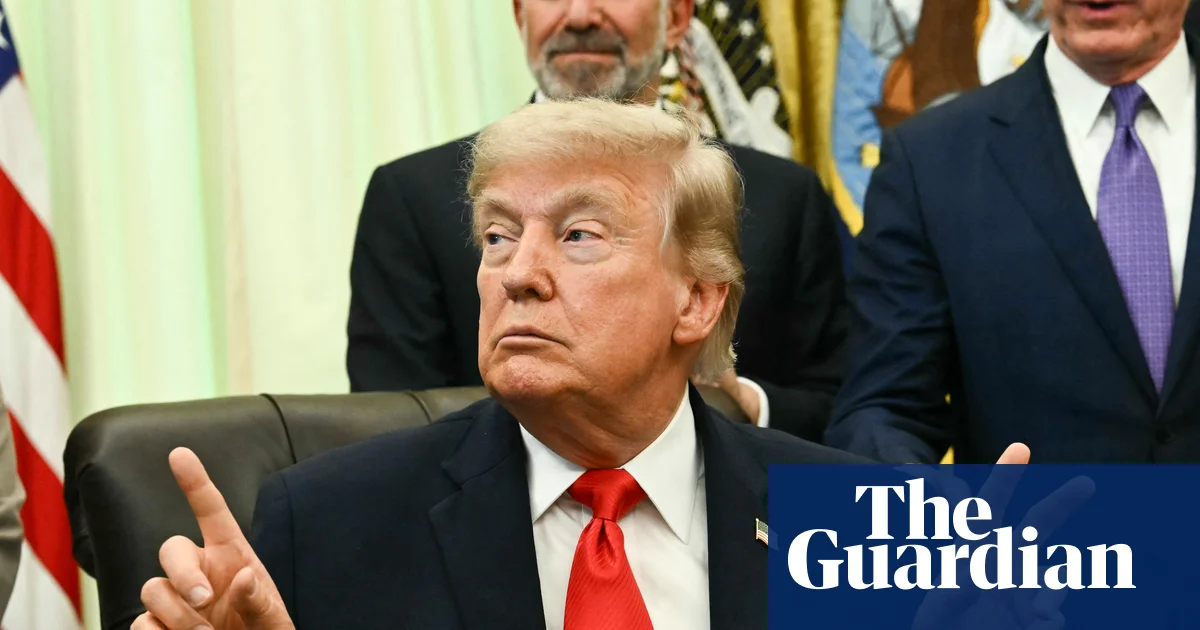
Donald Trump has said the US and Iran are on the verge of a peace agreement. Oil prices are down, and the stock market is up. This comes only hours after Trump warned Iran was about to be struck "VERY HARD", a threat that had sent oil prices up and stocks down. This was reported by Qazaqyia.kz citing The Guardian.
It has been another ride on the Trump rollercoaster, keeping traders on edge, most of the world poorer, and people of the Middle East constantly whiplashing between fear and hope. But whether the ride veers up or down, the management always makes money.
This is the 39th time that the president has declared US-Iranian talks to be on the point of fruition (other counts have the figure higher – it depends on what you term a prediction or just a hint). On five of those occasions, the promise of peace has involved walking back the threat of mass devastation, including the destruction of critical civilian infrastructure, a near-certain war crime if carried out.
As he was menacing Iran with "very hard" strikes on Thursday night, Trump also pledged the US would take over "total control" of the country's oil and gas markets and seize the island of Kharg. He has threatened the capture of Kharg, a focal point of Iran's hydrocarbon industry, several times before, although in this instance the threat was made while actually bombing Iran, in a tit-for-tat exchange with Tehran in which a critical reservoir and water tanks were badly damaged in the drought-stricken south, a war crime if intentional.
By Thursday afternoon however, the prospect of mass destruction had evaporated as quickly as it had materialised. "I have, as President of the United States of America, cancelled the scheduled strikes and bombings against Iran this evening," Trump declared on his Truth Social platform as if providing his full capitalised title added any weight to the statement.
The air of optimism was reinforced on Friday afternoon by a White House briefing that a text was in place which both the US and Iran could live with. US officials echoed the president's prediction that a signing ceremony could be held in a matter of days.
Iran's foreign ministry was less definite, saying that the proposed agreement was being studied by the country's "decision-making bodies", but the oil price fell below $90 a barrel nonetheless.
No matter how many times Trump predicts conflagration or diplomatic breakthrough, the markets still obediently bob up and down like a trained seal. It is a guaranteed response that represents an opportunity to make big, easy money for anyone with advance knowledge of presidential announcements.
A recent BBC investigation found that multimillion-dollar trades have been made in global markets just before Trump makes major administration announcements, particularly involving oil trades on the futures market.
After so many false dawns and hoax Armageddons, why are traders still reacting to Trump's rhetoric? One theory is that, while individual traders are no suckers, they suspect that some of their competitors might be, so react rapidly to presidential statements to get ahead of the curve.
An alternative explanation, suggested by the Australian-American economist Justin Wolfers, is what he calls the "known liar problem". The markets know Trump is an unreliable narrator and heavily discount everything the president says, but the economic implications of war or peace in the Gulf are so enormous that even a heavily discounted reaction still moves the dial.
After all, one day there will be a deal. The president's on-off signals are not being sent in a vacuum, but in the midst of talks between the two sides intended to turn the ceasefire, which has mostly held since April, into something more permanent.
According to reports from the region, the gaps in those talks are indeed getting smaller in the past few days. The focus is on a limited memorandum of understanding (MoU), putting off nuclear negotiations for later and focusing on opening the strait of Hormuz, a vital route for global trade.
The most immediate impasse has been about cash. Tehran has no confidence Trump would keep his word in any deal so wants to be paid up front from a $24bn tranche of an estimated $100bn of its assets frozen around the world, in return for lifting its blockade on the strait of Hormuz.
The US wants rewards to follow tangible progress, but the administration has a fundamental problem with releasing Iranian assets. Trump and other top Republicans have spent years lambasting Barack Obama for providing unfrozen assets to Iran in the form of pallets of cash as part of a 2015 nuclear deal, which was successful in curbing Iran's programme until Trump walked out of it in 2018.
The workaround being discussed, according to a source briefed on the talks, involves a line of credit from a bank in a Gulf state issued against Iran's $100bn of frozen assets as collateral. It will fool only those who want to be fooled, but that would include the administration's defenders on the American political stage.
The second major sticking point is how much detail about the agreement should be included. The US wants to include some provisions regarding Iran's nuclear program, but Tehran opposes this, as it contradicts the agreement to postpone nuclear talks. This issue remains unresolved.