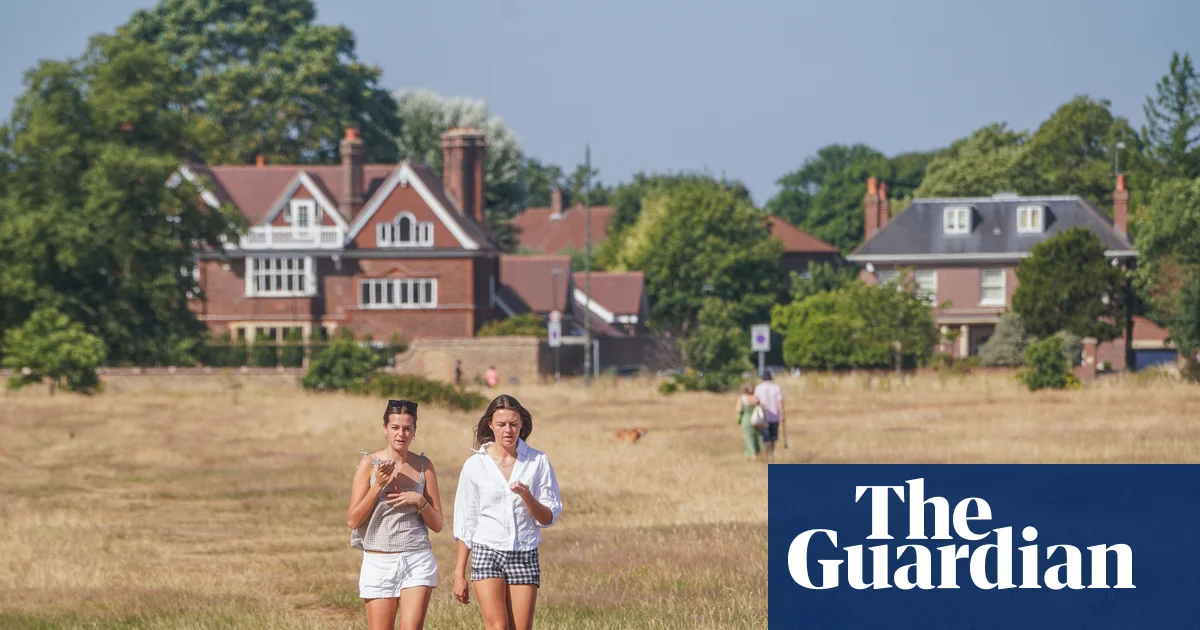
The scorching heatwave conditions experienced by much of England and Wales will last until at least next week, the Met Office has said. This was reported by Qazaqyia.kz citing The Guardian.
Temperatures in parts of England and Wales will continue to exceed 30°C on Sunday and into next week. While a risk of thunderstorms could develop in parts of the south from Monday, most areas are expected to stay dry, sunny and very hot.
A provisional maximum daily temperature of 33°C was recorded in Yelverton in Devon on Saturday. The Met Office said 2026 was the first year in which temperatures of 35°C were recorded in the UK on six days. Five days were recorded with temperatures over 35°C in 1976 and 2020. This year is also the first in the UK in which temperatures of 35°C or higher have been experienced across three months, and it has broken the record for temperatures of 34°C or higher, with nine days recorded so far at that level.
Emergency services have warned of an extreme risk of wildfires this weekend. The London fire brigade urged people not to use disposable barbecues over fears the dry heat could lead to fires. It said the risk in London grew from “elevated” to “extreme” on Saturday and would remain until Monday.
The Metropolitan police have said they are worried about excessive calls during England’s World Cup game against Norway on Saturday evening. A surge in emergency calls during the hot weather has prompted the force to urge people to call 999 only if there is an immediate danger or a crime taking place.
Craig Snell, a forecaster at the Met Office, said: “Today, 33°C is still well above average for the time of year. The very hot conditions are going to continue to remain across the UK until at least next week.” He added: “During the hot weather, make sure to stay hydrated, avoid prolonged exposure to the sun and check on friends and family. If you’re planning on enjoying the seaside, check the water temperature.”
Amber heat health alerts were issued by the UK Health Security Agency (UKHSA) for the West Midlands and the south-west, from 9am on Sunday to 9pm on Wednesday. This means significant impacts are likely across health and social care services due to the high temperatures, including a rise in deaths, particularly among those aged 65 and over or with health conditions. Yellow heat health alerts were posted for the East Midlands, the north-west, the south-east, the east of England and London.
The body of an 18-year-old man was recovered from the water near a weir at the Darley Abbey Mills complex, near Derby, after two teenagers got into difficulty. An 18-year-old man died at Dovestone reservoir, near Oldham, on Friday. The body of a woman was recovered from the Falls of Falloch in Stirling, Scotland, after she got into difficulty in the water on Friday evening.
The Met Office has warned of high or very high UV levels this weekend. A UV level of eight is forecast for most of England and Wales on Sunday. Pollen levels were also expected to be high or very high in some areas, particularly in Wales and the south-west of England.
Water firms have announced hosepipe bans for the east of England, the Cambridge area, Hampshire, the Isle of Wight and areas of Kent. Southern Water imposed restrictions for about 1 million customers across Hampshire and the Isle of Wight. Anglian Water imposed restrictions for its 5 million customers in the east of England. Cambridge Water announced a temporary hosepipe ban for its 350,000 customers, the first time in three decades. South East Water introduced a ban on 3 July for areas of Kent.