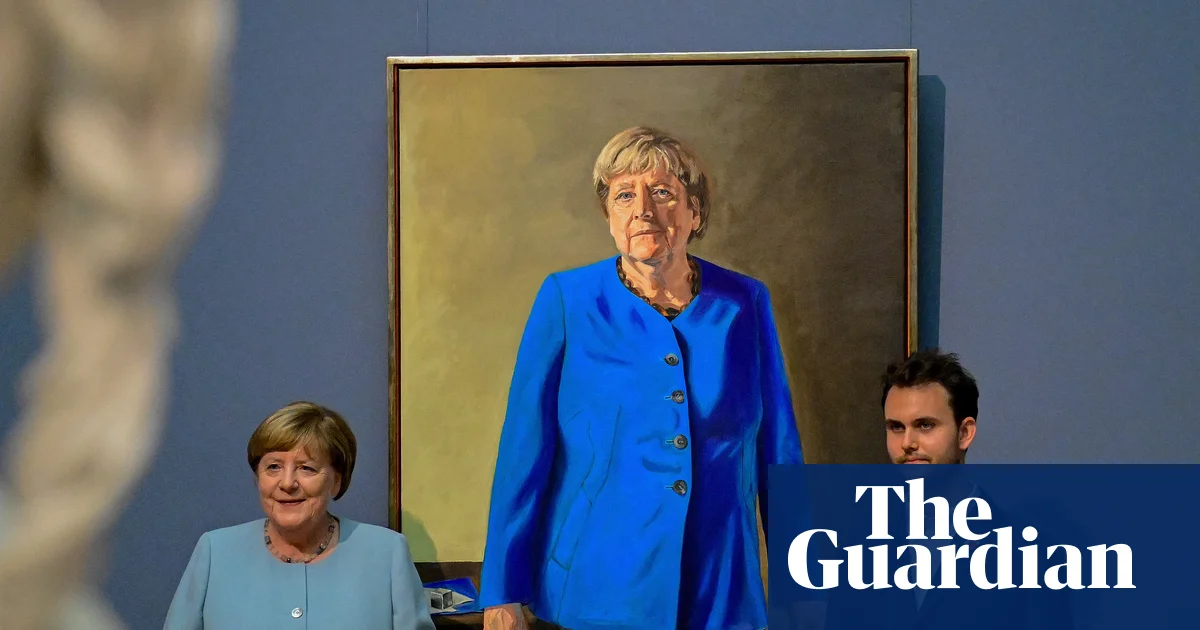
Former German chancellor Angela Merkel unveiled her portrait painted by artist Jérémie Queyras at the Bode Museum in Berlin. This was reported by Qazaqyia.kz citing The Guardian.
For months they met secretly in a studio in the government quarter of central Berlin – a young artist and his subject, the former German chancellor Angela Merkel. For hours at a time, while Jérémie Queyras painted her portrait, they bonded, Merkel said, chatting “about all and sundry”. Sometimes they were silent, or they listened to classical music, taking turns to choose the pieces.
The result of what Merkel, 71, called their “little adventure” was unveiled to an invited audience of family, friends and a handful of art critics this week in the neo-baroque Bode-Museum in Berlin. The painting shows Merkel in a blue version of one of her trademark blazers with big buttons. She looks a little cramped, her face slightly frayed; a sign, perhaps, that the strain of being in power for 16 years has left a permanent mark.
Queyras, 28, said he would “never have come up with the idea himself” but was persuaded to write to Merkel by an acquaintance. He sent Merkel a handwritten letter in 2022, enclosing colour photocopies of his paintings. He waited three years for a reply. When they met in her Berlin office, Merkel ignored his “scruffy sneakers” and gave him the commission, saying he had made a “good impression”.
The painter admitted he felt overwhelmed by the task and shared his doubts with Merkel. They discussed the meaning of a portrait and why an oil painting was preferable to a photograph. She advised him to take time to decide, warning that his life after the painting would be very different.
In preparation, Merkel arranged for Queyras to have secret access to the chancellery to view the gallery of portraits of her seven male predecessors. Notably, Merkel paid for the portrait herself, so her ownership cannot be disputed. The painting can be loaned to the chancellery, but Merkel could take it back if the far right comes to power.
Queyras gave considerable thought to how to paint Merkel’s hands. Her famous rhombus-shaped hand gesture was deemed too cliched, so in the portrait her left hand rests on the arm of a chair with three fingers, while her right hand hangs down. Behind her, on a table, are items from her office desk: a yellow cardboard file (a nod to her prosaic style of government) and a small silver cube engraved with “In der Ruhe liegt die Kraft” (“In serenity strength lies”).
The painting will be on display until October, then moved to the chancellery to hang next to a portrait of Merkel’s arch-rival Gerhard Schröder. Five years after Merkel left office, Germany is experiencing a wave of nostalgia for her era, encapsulated in the popularity of lo fi merkelwave.