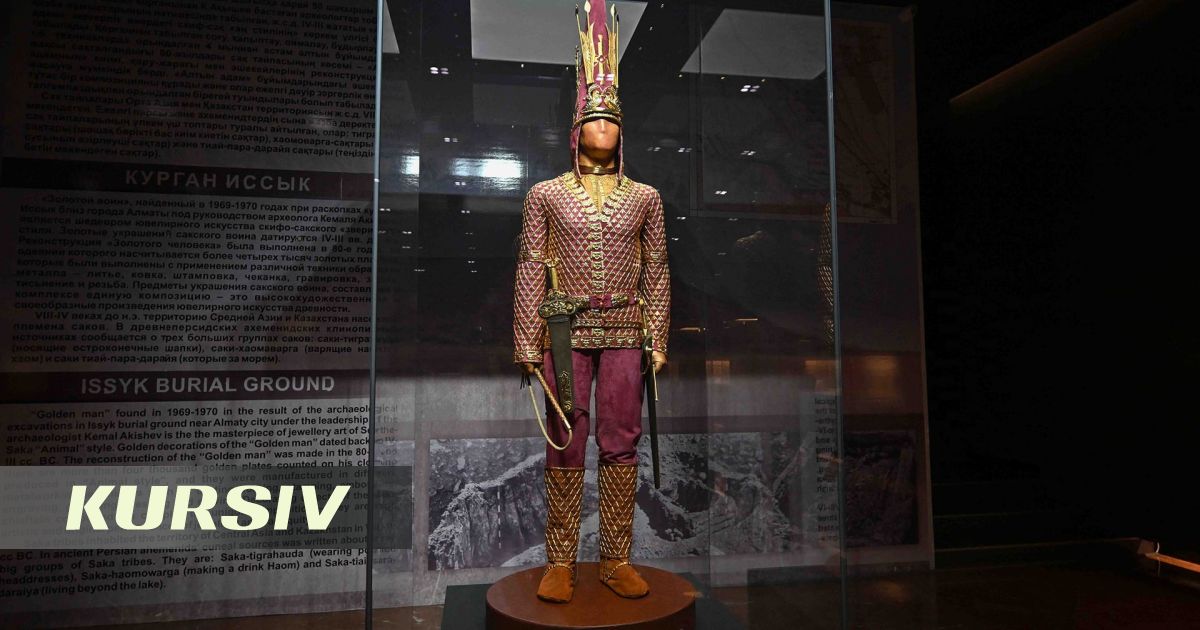
On Threads, Kazakhstanis questioned whether the 'Golden Man' found in the Issyk kurgan was male. Users claim there is still no consensus among scholars about the sex of the Saka warrior. This was reported by Qazaqyia.kz citing Kursiv Media.
Noël Shayakhmetov's sensational conclusion
According to the post's author, in 1970 the first Kazakh anthropologist Noël Shayakhmetov examined the bones from the Issyk kurgan and reached a sensational conclusion: a 16-year-old girl warrior lay in the golden armor. However, the Soviet academic leadership at the time harshly rejected Shayakhmetov's hypothesis.
21st-century research
Already in the 21st century, independent researchers deciphered the inscription on the famous Issyk silver bowl, which allegedly read: 'daughter of a warrior.'
The author's question
On Threads, the author asked: 'Shayakhmetov himself always acted strictly within the framework of science, restoring to us the faces of Makhambet, Kurmangazy and Koblandy batyr. But the main question is still open. What do you think: why does official science so stubbornly cling to the image of the "tsarevich," ignoring Shayakhmetov's arguments and the inscription "daughter of a warrior" on the Issyk bowl?'
Commenters' opinions
Commenters suggested that there were many such golden warriors, but most of the burials were looted. At the same time, other users recalled that DNA analysis of the 'Golden Man's' remains confirmed the presence of a male Y chromosome.
'I always thought the Golden Man was small for a man, especially for a warrior,' a user noted.
'Yes, we know, the headdress is most likely a saukele,' the author suggested.
Other users do not understand the point of these disputes at all, noting that the sex of the 'Golden Man' is not so important, since similar artifacts were found throughout Kazakhstan.
Scientific data
Recall that this year geneticists studied the DNA of the 'Golden Man' for the first time and determined his sex and tribal affiliation. According to the scientists' data published in the journal Science Advances, the famous artifact belonged to a man from the Saka tribe.
The burial dates to 400–300 BCE. More than 4,000 gold ornaments, weapons and a silver bowl were also found in the Issyk kurgan.
Earlier, 'Kursiv' wrote that Kassym-Jomart Tokayev showed the 'Golden Man' to the King and Queen of Belgium at the National Museum of Astana.