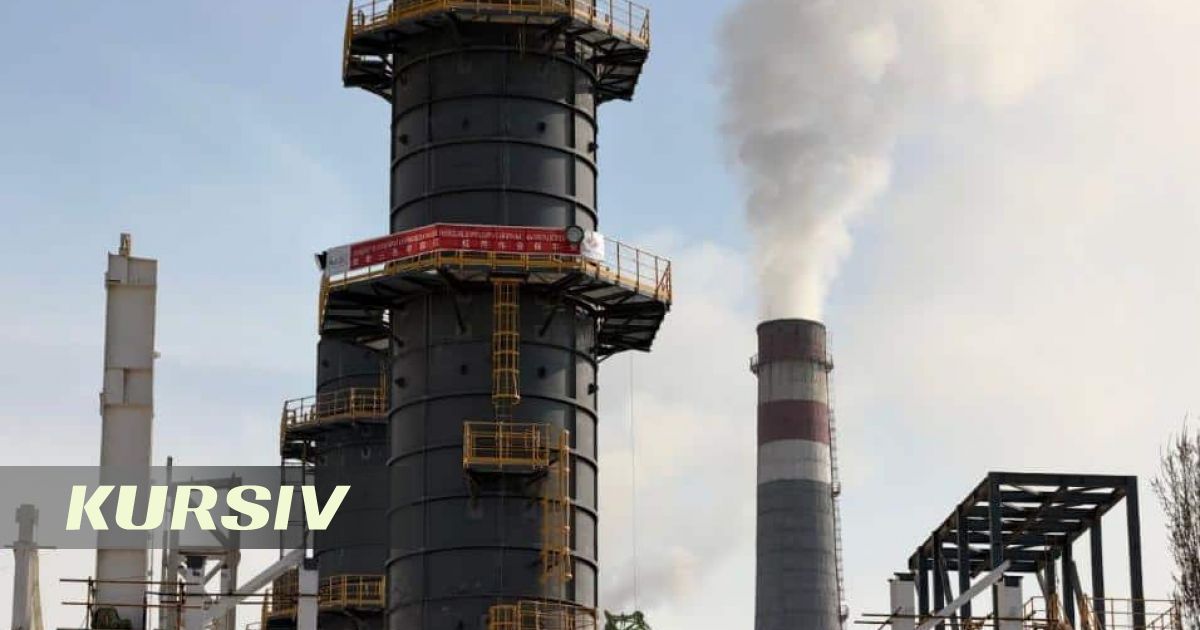
Coal-fired boilers and turbines at Almaty Combined Heat and Power Plant-2 (CHPP-2) will remain in operation until the 2030s. This was reported by Qazaqyia.kz citing Kursiv Media.
This follows from a conclusion on the results of an environmental impact assessment prepared by the Committee for Environmental Regulation and Control of the Ministry of Ecology and Natural Resources on a report on possible environmental impacts under the Almaty CHPP-2 modernization project.
"Based on the roadmap for the introduction of best available techniques approved by the Vice Minister of Energy on 23.05.2025 and the technical council protocol No.-08/1/2-261 dated 02.07.2025, for the period of commissioning and transitional modes after the gas part is put into operation during 2027-2029, including the winter maximum in operation, it is planned to preserve the functioning of the existing 4 steam boilers (KA st. No.2,4,6 BKZ 420-140-7s; KA st. No.8 E-420-13.8-560), 3 steam turbines (TA st. No.2,3 PT-80/100-130/13; TA st. No.6 T-110/120-130-5) in the autumn-winter period (AWP) and 3 steam boilers and 2 steam turbines in the summer period," the documentation of Almaty Electric Stations (owner of Almaty CHPP-2, part of Samruk-Energo) for public hearings, which is available to Kursiv, says.
At the same time, "in order to avoid disruption of uninterrupted supply of thermal and electrical energy to consumers" due to possible failures in the supply of natural gas, it is planned "from 2030 through the 2030s" (the exact end date of operation of coal boilers and steam turbines is not specified, so most likely it means their operation at least until 2039) to keep four steam boilers and three steam turbines in operation during heating seasons, as well as three steam boilers and two steam turbines on coal in the summer period.
It is traditionally believed that the cost of heating with inexpensive Ekibastuz coal, mined by open-pit method, is still competitive provided that depreciation of generating equipment has already passed. As for natural gas, despite the declared large gas reserves, subsoil users continue to inject associated gas back into the formation in order to obtain more oil, which is exported at world prices.
Gas supply to the south, north and center of the country goes through the Beineu-Bozoy-Shymkent main gas pipeline, which for several years in a row has been operating at the limit of its throughput capacity in the autumn-winter period. This leads to a reduction or even zeroing of gas exports from Kazakhstan to China during this period. At the same time, akimats and QazaqGaz continue gasification and connection of new consumers to gas, including large industrial enterprises, which will increase gas consumption. Perhaps this demand will be covered by imports of Russian gas, but its price will be higher than that of Kazakh gas, so the question arises about the rise in the cost of thermal and electrical energy generated so far by the coal-fired CHPP-2 and CHPP-3 in Almaty using future gas.
"Currently, the installed electrical capacity of CHPP-2 is 510 (445) MW, thermal – 1,411 (952) Gcal/h. According to the selected reconstruction option for Almaty CHPP-2, the construction of a GT-CHPP (gas turbines – Kursiv) with an installed capacity of 557 MW (electrical capacity), 957 Gcal/h (thermal capacity) is envisaged," the documentation states.
This refers to Siemens Energy gas turbine units, as well as Chinese equipment (turbines and boilers) of the Dongfang Boiler and Dong Fang Turbine brands.
By the end of 2026, combined-cycle units with a capacity of 557 MW and 200 MW (first stage), respectively, were to be launched at Almaty CHPP-2 and CHPP-3, which was supposed to convert them from coal to gas. However, KEGOC Management Board Chairman Nabi Aitzhanov at a government meeting on preparation for the heating season on August 25 proposed continuing the operation of coal-fired equipment amid an electricity deficit.
In turn, Samruk-Energo Managing Director Galymbek Autalipov said that the progress of CHPP-2 modernization at that time was 94%, and the supply of main and auxiliary equipment for CHPP-3 was 95% complete (the remaining equipment was expected to be received within the next 45 days). At that time, final installation work on the steam turbine and commissioning processes were underway. According to him, for the upcoming heating season, a decision was made to "keep the existing coal-fired CHPPs in full readiness in case of emergency situations with gas equipment and interruptions in gas supplies." Thus, the national company, which manages Almaty CHPP-2 and CHPP-3, which are to be converted from coal to gas, is announcing at least a transition period when coal equipment will continue to operate.
More than 16 million tons of coal will additionally be required for new coal-fired power plants and CHPPs, Vice Minister of Energy Sungat Yesimkhanov (later became a Kurultai deputy) told journalists in February. Kazakhstan is among the top ten largest countries in terms of coal production and existing geological coal reserves (33.4 billion tons). In recent years, coal production has remained at about 112 million tons per year.