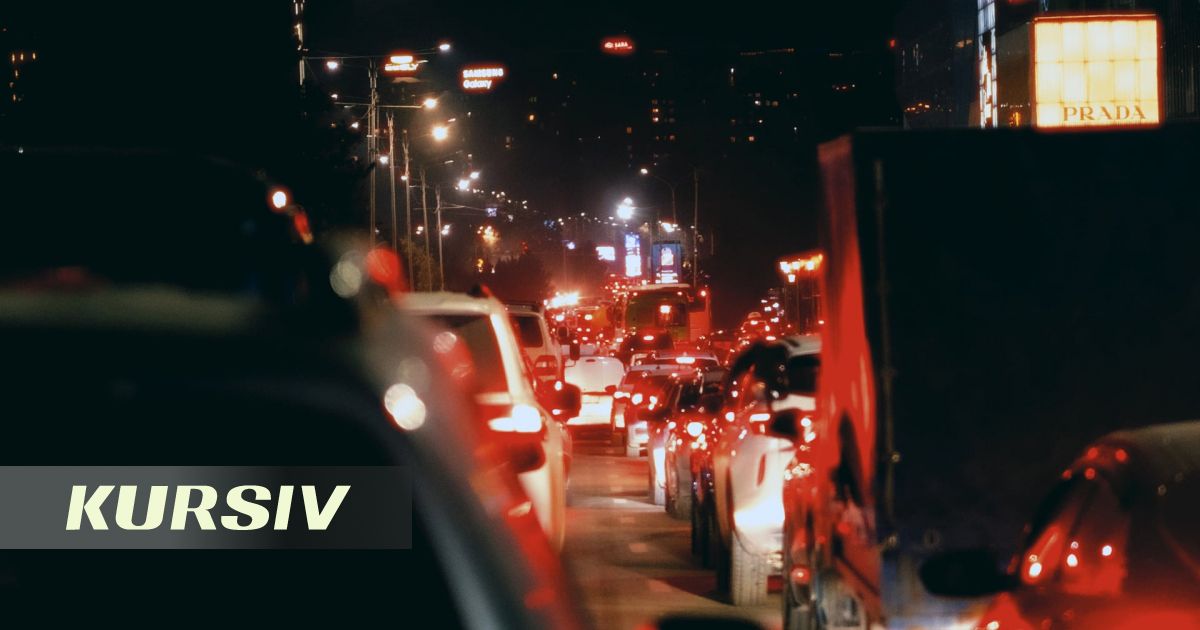
Urbanist and former head of the passenger transport department Dauren Alimbekov recently proposed a way to eliminate traffic jams in Almaty over the summer on his social media. Kursiv LifeStyle met with the former official and asked him in detail how he promises to achieve such a fairy-tale result. This was reported by Qazaqyia.kz citing Kursiv Media.
To bring us down to earth, the expert clarified the terms. He does not propose to completely get rid of traffic jams; this is impossible in a big city. The goal is to reduce congestion to a tolerable level: during rush hour, cover a distance in half an hour that would take 20 minutes early in the morning without traffic.
"In my understanding, reducing traffic jams means driving along Al-Farabi Avenue to Shalyapin Street or Dostyk Avenue in 35-40 minutes during rush hour," he explained.
In his opinion, three key measures are needed. Spoiler: no billions of tenge required. First, bus routes for residents of the agglomeration need to be changed.
"The city already has 4,000 buses. That's enough to provide Almaty with a full network. Without adding new vehicles, we need to extend bus routes from the suburbs, for example, from Talgar or Kokkaynar. Currently, they reach the outskirts of the city, and people need to transfer to get to the center. It's easier for them to drive straight away. If there were no need for a transfer, people would switch from cars to buses," the urbanist believes.
Cars of suburban residents, according to the specialist, account for only 5-10% of total traffic. (In these and subsequent figures, Alimbekov relies on data from Sergek cameras for 2025 — editor's note). But even a 10% reduction will have a noticeable effect.
"Traffic jams in front of Almaty start as early as 6 a.m. In the morning, residents don't notice them much because the 'tail' of the jam remains outside the city. In the evening, it's the opposite. Look, suppose a section of road passes 100 cars per minute. That means it will pass 600,000 per hour. But if it's 110 cars per minute instead of 100, 600 cars of traffic jam will accumulate in an hour — that's about 5 blocks. If we reduce the jam by just 5 blocks, it will be noticeably easier for us," the urbanist explained.
As confirmation, Alimbekov recalled last year's autumn holidays. Then, for a week, according to the Sergek system, traffic jams in the city decreased.
At the same time, the same number of cars entered the city per hour as before the holidays, and they moved around Almaty similarly. But at certain times, they did not concentrate near schools.
Traffic was still dense but uneven, and this already reduced jams. Waiting was necessary, but not for hours. Traffic decreased by 10-20%. In other words, if buses start running at normal predictable intervals and only 10% of residents switch to them, improvements will already be noticeable. In 2026, during summer holidays, traffic decreased by 15%, and during rush hour by 30%.
"People tell me: 'What if I need to go to several places, carry heavy things, how can I do without a car?' But such a need doesn't arise every day. However, if people stop driving to the office every day, traffic will already decrease," the urbanist believes.
The remaining two factors for defeating traffic jams, besides extending suburban bus routes, are closely related. They are dedicated bus lanes and one-way streets.
For a bus to move faster than a private car overall, dedicated lanes are needed throughout the city. Moreover, not necessarily along the entire length of streets, only on the busiest sections. Lanes for them can be found without expanding roads, the urbanist believes — streets need to be made one-way.
One-way traffic will provide an additional bonus. When turning left, a queue of cars will no longer block oncoming traffic — this will also help prevent jams.
"With one-way streets, mileage increases, but travel time decreases. We already make extra mileage now: for example, people drive along Al-Farabi Avenue, although Timiryazev Street might be closer for them," our interlocutor noted.
With one-way traffic throughout the city, the BRT on Timiryazev, according to Alimbekov, should be removed.
Suppose the result is achieved and traffic jams are reduced by 10%. Deferred demand will likely kick in.
"I don't schedule any meetings in Almaty from 5:00 p.m. to 7:00 p.m. to avoid traffic jams. If driving becomes faster, my plans might change. Simply put, when there are two streets nearby, one congested and the other empty, cars gradually fill the second one too," the expert explained.
To prevent jams from returning to previous levels, LRT and SkyTrain will help in this case.
"When we decided to abandon the tram in 2015, I spoke with foreign experts about LRT. And they told me a word that I later didn't know how to replace at official meetings: 'LRT is sexier than a tram.' There are even studies showing that a motorist is more willing to switch to this mode of transport than to a regular bus," the expert said.
At the same time, developing both LRT and SkyTrain, the urbanist believes, should primarily be in Almaty itself, where 80% of automobile traffic is concentrated, not on the outskirts.
Earlier, Kursiv wrote about how traffic jams in an elite district of Almaty were explained by poor ditches.