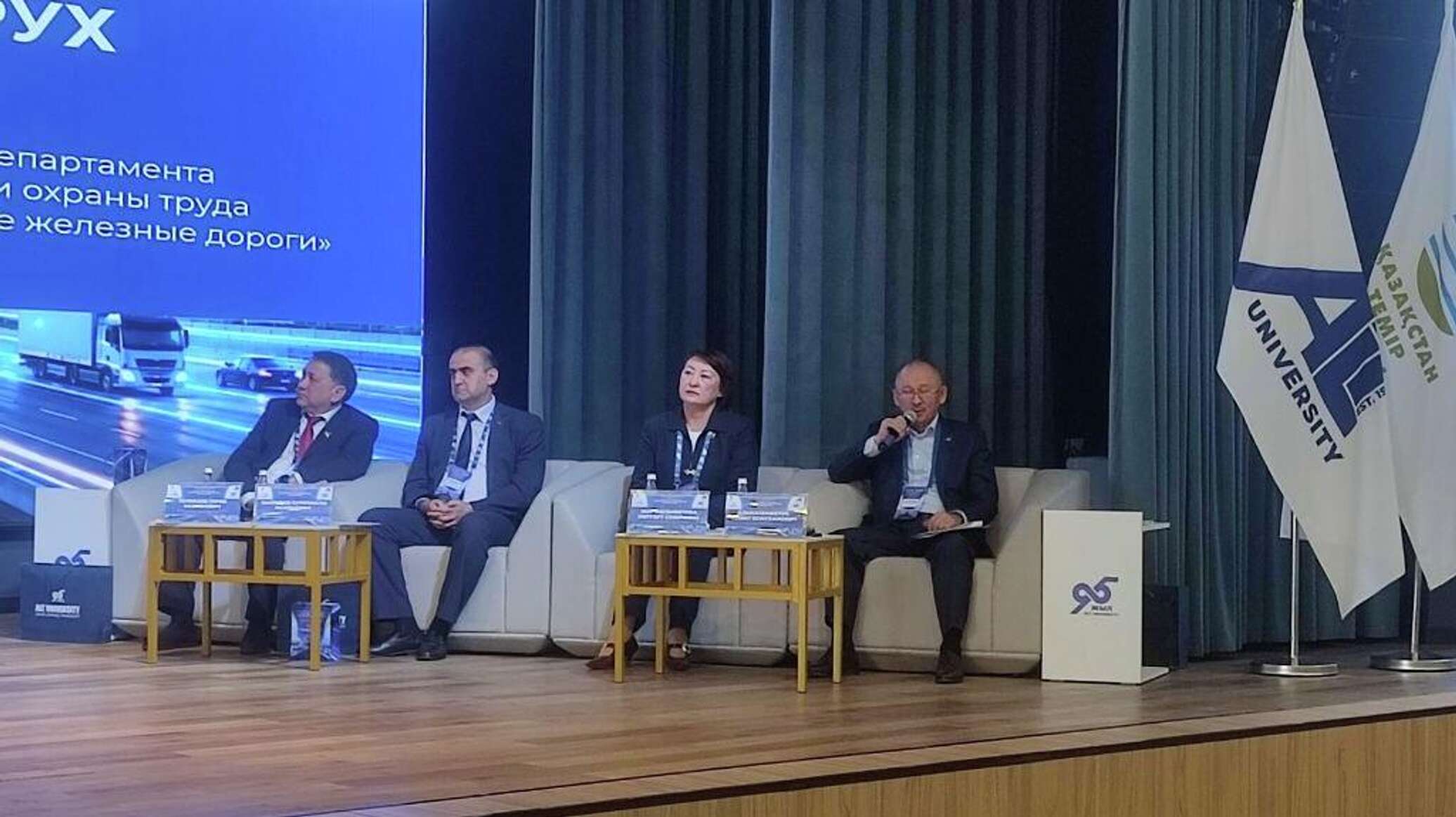
At the VII Eurasian Transport Safety and Digitalisation Forum held in Almaty, one of the main topics was the training of a new format of specialists proficient not only in traditional railway technologies but also in automation, digital systems and artificial intelligence. This was reported by Qazaqyia.kz citing Sputnik Kazakhstan.
In recent years, the strategic importance of developing transport infrastructure, especially in the countries of the Eurasian Economic Union, has been discussed at various levels. This topic is particularly important for Kazakhstan, as the country is a key link connecting Europe and Asia, as well as the north and south of the continent.
“Five main railway corridors pass through our territory. This has turned Kazakhstan into an important hub of the global transport network. By actively developing the east-west and north-south directions, Kazakhstan is forming a reliable and integrated transport system. This strengthens the country’s role as a connecting bridge in the Eurasian space and takes regional ties to a new level,” said Marat Shakenov, Deputy Chairman of the Management Board of Kazakhstan Temir Zholy National Company JSC.
He noted that the volume of freight transported by rail is growing every year. Currently, KTZ ensures the operation of about 16,000 kilometres of railway network. The company operates more than 2,000 locomotives and 41,000 wagons. More than 118,000 people work in the system. More than 319.9 million tonnes of cargo are transported annually.
Due to the steady growth in rail freight volumes, the EAEU countries are paying more attention to safety issues. According to forum participants, the development of digitalisation and artificial intelligence plays an important role in this area.
“We also constantly monitor the situation on the railways of Europe and the United States. We study where emergencies, accidents or train crashes have occurred and take measures to prevent such cases from recurring here. We are now introducing artificial intelligence in track diagnostics across all sections of the railway network. Smart diagnostics and smart locomotives are being used. In other words, we constantly monitor what solutions and technologies can significantly improve railway safety,” said Marat Shakenov.
At the annual forums, representatives of the railway industry of the EAEU countries exchange information about new technologies and their implementation experience. For example, Vladimir Pyastolov, Deputy General Director of Russian Railways, described how work is being carried out in Chelyabinsk to introduce robots and driverless locomotives. The digital system is already operating at Chelyabinsk-Glavny station. It integrates data collection, processing by algorithms and the operation of the relevant mechanisms into a single system. Some technological operations have already been transferred to robotic systems.
“It is these systems that actually implement the solutions: infrastructure elements, robots and driverless locomotives,” Pyastolov said at the forum. According to him, in the near future the experience of Chelyabinsk-Glavny station is planned to be used as a basis for introducing such technologies at other stations in Russia.
Another important topic of the forum was the training of specialists and engineers of a new format for the railway industry. No matter how much artificial intelligence develops, human resources will continue to play an important role in the railway transport sector for a long time. According to Meruyert Zharmagambetova, Rector of ALT University, the management of the institution is already striving to create conditions for students to understand real production processes during their studies, work with modern equipment and solve practical tasks.
“Thanks to the support and understanding of Kazakhstan Temir Zholy national company, we are opening up new opportunities for the practical training of our students. New laboratories, training centres and training grounds that are as close as possible to the real working conditions of the railway industry are being created and developed at the university,” she said. Meruyert Zharmagambetova noted that investment in education is the most important investment in the safety and future of the railway industry.