On September 24, the exhibition "Zhetikarakshy" (Jetykaraksi) opened at Vlad Slutsky's Egin space in Almaty, showing time, distances and space through the prism of renowned Kazakh artist Ashat Akhmedyarov. This was reported by Qazaqyia.kz citing Kursiv Media.
Kursiv LifeStyle visited the vernissage at 79 Nurmakov Street.
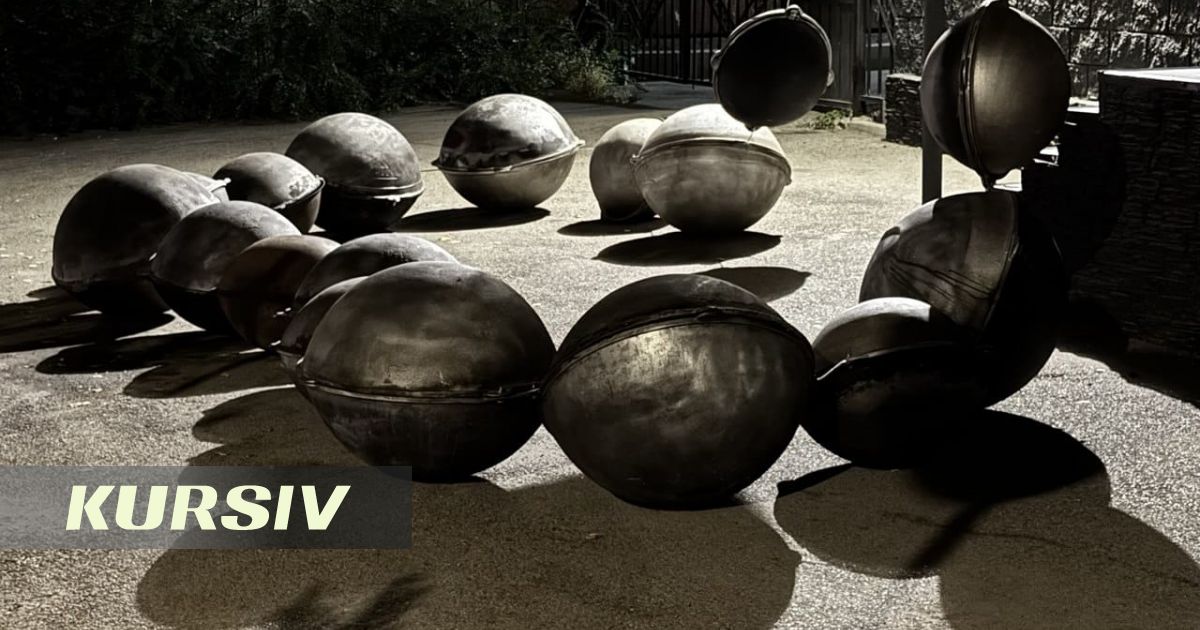
At the entrance to the gallery, guests were greeted by a large installation of kazans bolted to each other. The kazan holds enormous significance in Kazakh culture as the main source of cooked food. Akhmedyarov told Kursiv LifeStyle that he created a huge necklace from various kazans. According to the artist, who grew up in western Kazakhstan, he always saw only women at the hearth.
In the context of the tragic events in Mangystau, where 14 people died during exercises, the kazans on Nurmakov are now seen differently — as overturned vessels — a Kazakh symbol of tragedy, misfortune and desolation. Moreover, although the kazans are new, the artist did not make them gleaming new but smeared them with soot — as a reference to history.
The Egin exposition covers a two-year period of Ashat Akhmedyarov's work from 2024 to 2026. In the first hall, visitors can watch a film titled "Zholshybai" (from Kazakh — fellow traveler). The artist himself starred in it. On screen is the eternal path of the Kazakh — constant movement. The artist himself speaks of it more simply and decided to star in it because of memories of railway journeys.
"In my youth I often rushed between Uralsk, where I was born and grew up, and Shymkent, where I studied. And I looked out the train window, studying the geography of Kazakhstan and the different people inside the train. And it all imprinted itself as my experience, everything mixed together on the platform and in the train. You could say this is a film-self-portrait," Ashat Akhmedyarov told Kursiv LifeStyle.
The large hall of the gallery was repainted from white to grey to emphasize the current exposition. In simple wooden frames is the photo series "Family Portrait" made from scorched fabrics and photographs of the women of the Akhmedyarov family. In one photo, the incredible resemblance of the grandmother to the artist's brother — renowned Kazakh journalist Lukpan Akhmedyarov — is noticeable.
Part of the photos is embroidered with multicolored threads — according to Akhmedyarov, these are motifs of an old Turkmen carpet that the artist saw at home since childhood and that migrated with his family.
The exhibition was organized with the support of the AMA Foundation for Culture and Education, which supports the development of cultural and educational projects in western Kazakhstan. Its founders — Asel Akhmetzhanova, Asel Mukasheva and Malika Urazgaliyeva — previously launched and managed the YEMAA center of contemporary culture in Atyrau. The two Asels also curated the "Zhetikarakshy" exhibition.
"Besides the exhibition itself, which will last until the end of October, we have prepared a program — it will include a curatorial tour, and in October — a conversation with Ashat Akhmedyarov and a lecture by Dmitry Melnikov later, follow the announcements," said Asel Akhmetzhanova.
The exhibition also features several sculptures, one of which Akhmedyarov called "Branch of a Wild Apple Tree." All the exhibits, one way or another, are the author's reflection on himself, Kazakhstan and nomadic culture.
Ashat Akhmedyarov was born in 1965 in the village of Alexandrovo in the West Kazakhstan Region, and studied at the art college in Shymkent, including under the founders of the "Kyzyl Traktor" art group. His current exhibition tells of memory against the backdrop of a changing world that constantly demands human attention, and will last until the end of October at 79 Nurmakov Street.
Art historians, art figures and art lovers gathered at the exhibition called it one of the best in Almaty today. It was also liked by a group of young tourists from Finland who appeared unexpectedly. They accidentally wandered into Egin Atrspace and came into contact with contemporary Kazakh art for the first time in their lives.
Earlier, Kursiv LifeStyle wrote about an exhibition at the Abai Kazakh National Academic Opera and Ballet Theatre, which Timur and Dinara Kulibayev attended.