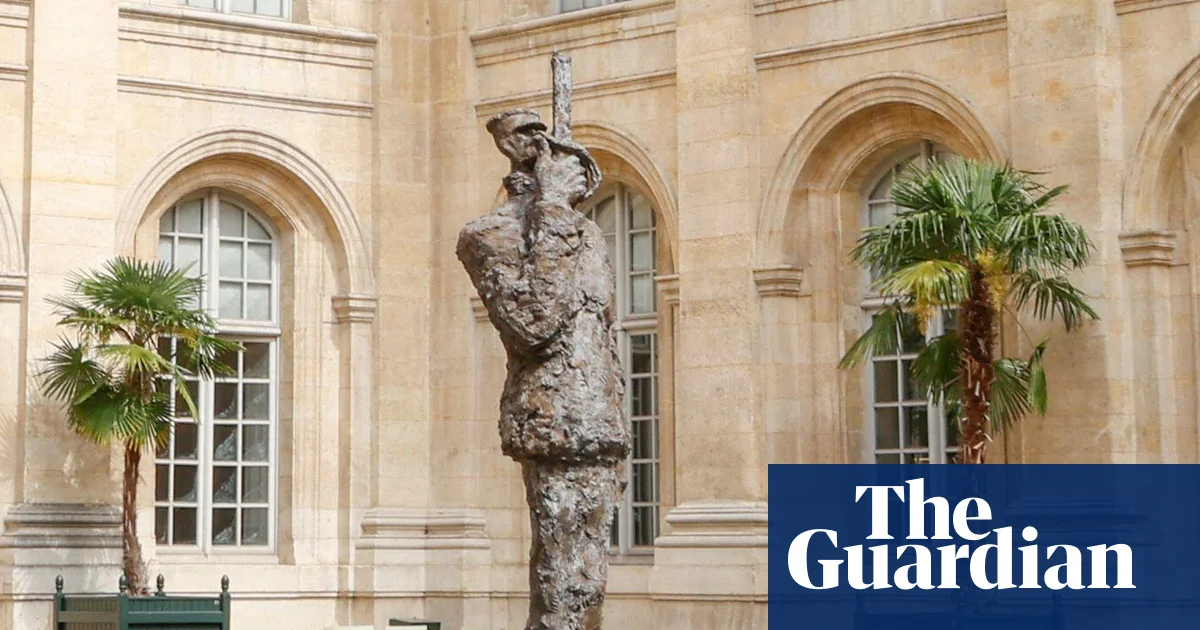
For 40 years, the statue of Capt Alfred Dreyfus has been moved around Paris, never finding a permanent home. The French army twice refused to allow it to stand at l'École Militaire, where Dreyfus, a Jewish officer it had wrongly accused of treason in 1894, was stripped of his rank in one of the most notorious acts of antisemitism in France's history. This was reported by Qazaqyia.kz citing The Guardian.
This was reported by Qazaqyia.kz citing The Guardian.
A spot opposite the city's Palais de Justice was considered and rejected. For want of a better place, the bronze statue created in 1985 was placed in the Tuileries garden, then tucked away across the River Seine near the former site of the Cherche-Midi jail, where Dreyfus was imprisoned after his arrest.
Now, 120 years after the officer's name was cleared, and a year after he was posthumously promoted to the rank of brigadier general, his statue has been given what many believe is its rightful place in central Paris. On 12 July, a national Dreyfus commemoration day, Emmanuel Macron, the French president, and Emmanuel Grégoire, the mayor of Paris, will unveil the 3.5-metre (12ft) figure in Rue de Harlay on the Île de la Cité. It will stand in front of the cour de cassation, France's highest civil court, which finally exonerated Dreyfus on 12 July 1906.
"From now on, every July 12, a commemorative ceremony will be held for Dreyfus, celebrating the victory of justice and truth over hatred and antisemitism," Macron wrote last year. "Thus, Alfred Dreyfus and those who fought through him for liberty, equality and fraternity will continue to serve as the example that must inspire our conduct."
Ariel Weil, the mayor of Paris Central and a descendant of the Dreyfus family, has been one of the main people pushing for the statue to have a prominent, permanent home. Until now, he said, the attitude of the state and authorities had been: out of sight, out of mind. "It's been wandering around Paris for years," Weil said. "The general idea seemed to be: we'll put it in a corner of Paris where it won't embarrass anyone and won't be seen and we can forget about it. It was in a place nobody wanted, not historians, not the Dreyfus family, not the artist."
The Dreyfus affair is one of the most notorious political events in French history and almost brought down the Third Republic. The army accused Dreyfus of passing military secrets to the Germans and convicted him of treason at a secret court martial in 1894. It then cashiered him – dishonourably dismissing him and stripping him of his military rank – in a humiliating public ceremony where his sword was broken and the rank insignia buttons and braid ripped from his uniform. He was transported to life in solitary confinement on Devil's Island, a penal colony off French Guiana.
Three years later, the French military discovered much of the evidence against Dreyfus had been forged and that it had been another officer who had passed the infamous "bordereau" note to the Germans. However, they kept the discovery secret. After it was revealed and Dreyfus still not pardoned, the novelist Émile Zola, outraged, published his open letter, J'accuse.
When the cour de cassation exonerated Dreyfus he was readmitted to the army and made a member of the Légion d'honneur. After serving in the first world war behind western frontlines, he retired and died in Paris in 1935, aged 75.
Fifty years later, the government of the Socialist president François Mitterrand commissioned the statue from Louis Mitelberg, known as Tim, a political cartoonist and Jewish Pole. The line: "If you want me to live, help me regain my honour", taken from a letter the incarcerated Dreyfus wrote to his wife, Lucie, is carved on the pedestal.
The statue was intended to be placed in the courtyard of l'École Militaire. But when military officers vetoed this, Mitterrand did not insist. Several other suggested sites were refused. Weil said: "As president, Mitterrand was head of the military and if he had said: 'It goes in the École Militaire courtyard', where it was supposed to go, that's where it would have gone. But he didn't."
After a six-year sojourn in the Tuileries, the statue was moved in 1994 and tucked away on Place Pierre Lafue. Resin copies of the work, one placed in the Museum of Jewish Art and History in Paris and a second in Tel Aviv, became better known than the original. In 2002 vandals painted a Star of David and "dirty Jew" on the statue.
"The Dreyfus affair is one of the five most politically significant events in the history of France," Weil said. "As well as the antisemitism, there was the question of the influence of the army within the state and all the values promised by the republic. A great deal was at stake in the Dreyfus affair. The statue is being placed in an incredibly powerful spot in the very centre of Paris. It is perhaps fitting that the statue is not being placed in École Militaire."