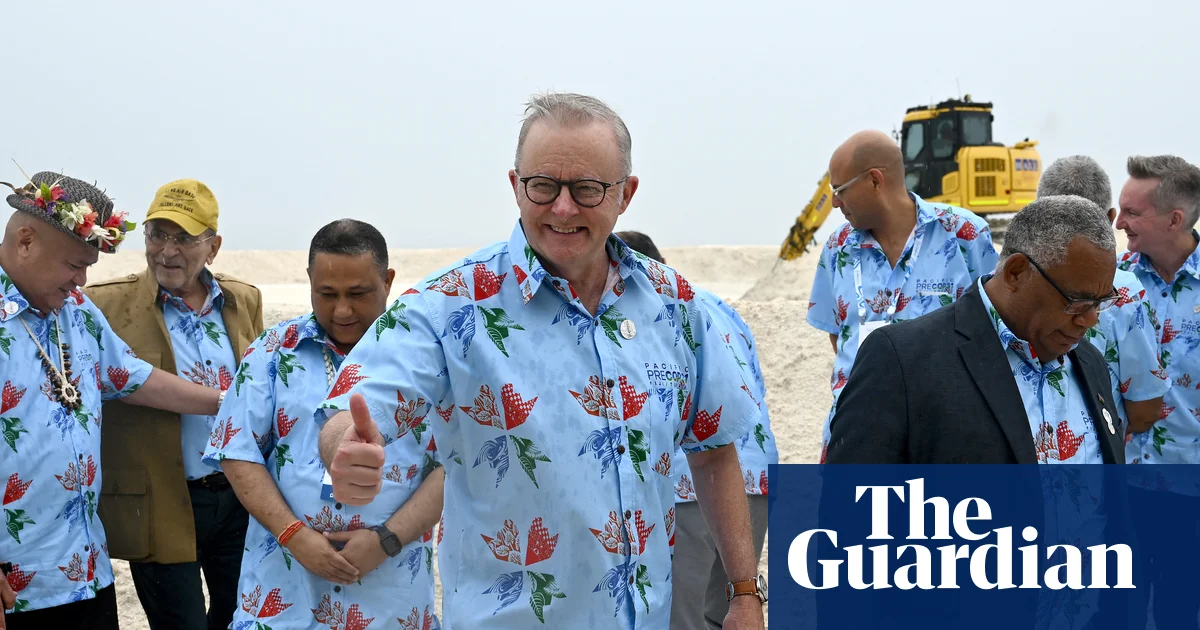
Australian Prime Minister Anthony Albanese visited Tuvalu as part of the pre-Cop31 climate conference in Fiji alongside Pacific island counterparts. This was reported by Qazaqyia.kz citing The Guardian.
One of the most powerful moments of the trip came when 13-year-old Melelusi Sokotia addressed the delegation, speaking about how her friends' aspirations to be "teachers, doctors, builders" were being overridden by the basic question of whether they could "grow safely here in Tuvalu". Melelusi made a plea: "Please work together to protect small islands like ours."
Tuvalu is described as the least visited country on the planet. Its land totals just 26 sq km, mostly narrow strips less than 2 metres above sea level. According to Nasa researchers, the rate of sea level rise around Tuvalu is about twice the global average. It means the edges of the nation are being eroded.
The delegation was given a presentation illustrating the escalating threat of floods and storm surges washing through homes and infrastructure in the years ahead. They also saw an example of what the country is doing to give itself the best chance to survive, visiting a land reclamation project on the main atoll of Funafuti that is mostly funded by the Australian government. Sand and gravel dredged from the lagoon is being used to create more than 20 hectares of new, higher ground.
Later, back in Fiji, a leaders' plenary heard from Nepali foreign affairs minister Shisir Khanal, who travelled for the pre-Cop meeting while his country staggers under the fallout from devastating flooding in August. While the Pacific confronts a crisis of rising tides and more fierce cyclones, Khanal said Nepal was threatened by melting mountain ice bringing havoc from above. He pointed out the two threats were linked. Melting glaciers ultimately add to rising seas.
The minister said Nepal and the Pacific had something else in common. Neither contributes much at all to the global emissions causing these catastrophes. "Yet our people pay with their lives and development gains for a crisis they had no hand in creating," he said. "This is the very definition of climate injustice."
Albanese didn't ignore this. He took Khanal's message on enough to repeat part of it – that Nepal faced "extraordinarily traumatic" climate events despite running entirely on hydroelectricity – in a speech before flying out on Wednesday. He described other examples of extreme events becoming less predictable and more intense as "the science told us would occur". Climate change wasn't an abstract future challenge, but "a daily reality that communities are dealing with". "We saw that first-hand yesterday in Tuvalu," Albanese said.
The point of Albanese's speech was to argue for more international investment in the Pacific Resilience Facility, a fund designed to help people in the region cope and live that has received A$100m in Australian government support. He didn't mention coal.
But when held up against his commentary about the high court judgment, it wasn't hard to see a screaming internal contradiction – a case of a leader sending conflicting messages to different audiences. On Wednesday, the High Court sided with community members in the Hunter Valley to strike down a state regulator's approval of a massive coalmine expansion that could have kept it operating until 2048. This is likely to prove a historic victory and may yet have ramifications for other fossil fuel expansions.
If comments he made in May are taken at face value, the judgment may not please Anthony Albanese. Speaking on 2HD radio in Newcastle, the prime minister said the renewable transition was needed, but the government supported "existing industries" – that is, coal. He hoped the community group would lose as the Mount Pleasant mine expansion had "been through appropriate approvals".
Critics were quick to note the contrast between Albanese's language opposing legal action to stop a coalmine and the message he delivered over the past three days at a climate conference in Fiji in preparation for the Cop31 summit in Turkey next month.
With Pacific island counterparts, the prime minister helped lead a delegation of about 50 dignitaries to the atoll and reef island nation of Tuvalu. Remote and tiny doesn't do Tuvalu justice. It is described as the least visited country on the planet.
Does Albanese disagree with the high court judgment and still support coal expansion, given its contribution to the crisis he has accurately identified? There was no chance to test this on Wednesday. He left pre-Cop without taking questions from journalists.
None of this is to dismiss the work being done in Fiji.