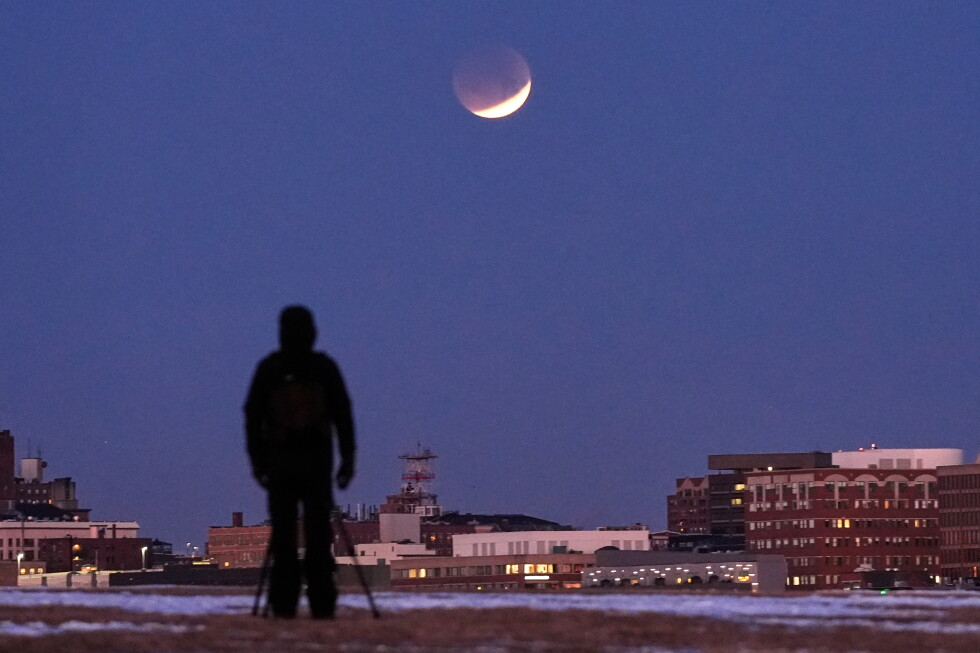
A near-total lunar eclipse — a deep partial eclipse that will cover 96% of the moon — will occur on Aug. 22, 2026. This was reported by Qazaqyia.kz citing Associated Press.
The lunar eclipse happens because of the precise alignment of the moon and the sun. It comes two weeks after a total solar eclipse paraded through Greenland, Iceland and Spain. Eclipses always travel in pairs as the sun, moon and Earth align so precisely that one obscures the other.
The eclipsed moon will be visible to billions across North and South America, Europe, Africa and the Middle East. Nearly 1 billion people in the U.S., Canada, and Central and South America will have front-row views for the entire eclipse. More than 3 billion people — 44% of the world's population — will be in position to catch at least part of it.
The eclipse will peak just after midnight EDT. The partial phase will last more than three hours, while the entire eclipse will stretch 5 ½ hours.
This is the year's second lunar eclipse and the fourth eclipse overall. A total lunar eclipse graced the skies over the Americas, Australia and eastern Asia in March. The next complete lunar blackout won't be until New Year's Eve 2028, with Asia and Australia at center stage.
NASA astronaut Jack Hathaway told The Associated Press from the International Space Station: "This is a great time to be part of the space program, right? We're not slowing down."
Space station commander Jessica Meir said space provides a "unique perspective" for viewing cosmic wonders like eclipses and auroras.
During the eclipse, Earth will pass between the moon and the sun, casting a reddish-orange shadow onto our closest neighbor. Because this is a partial eclipse, it won't be a true blood moon.
The lunar eclipse may also be visible to Hathaway and the nine other people living off the planet — seven astronauts at the International Space Station and three aboard China's orbiting outpost.
The eclipsed moon will be setting in Europe, Africa and the Middle East, cutting the show short. It will be rising in Hawaii, getting the eastern Pacific off to a late start along with northwestern sections of the U.S. and Canada.
It will be 2029 before stargazers across North and South America are treated to another full eclipse of the moon.