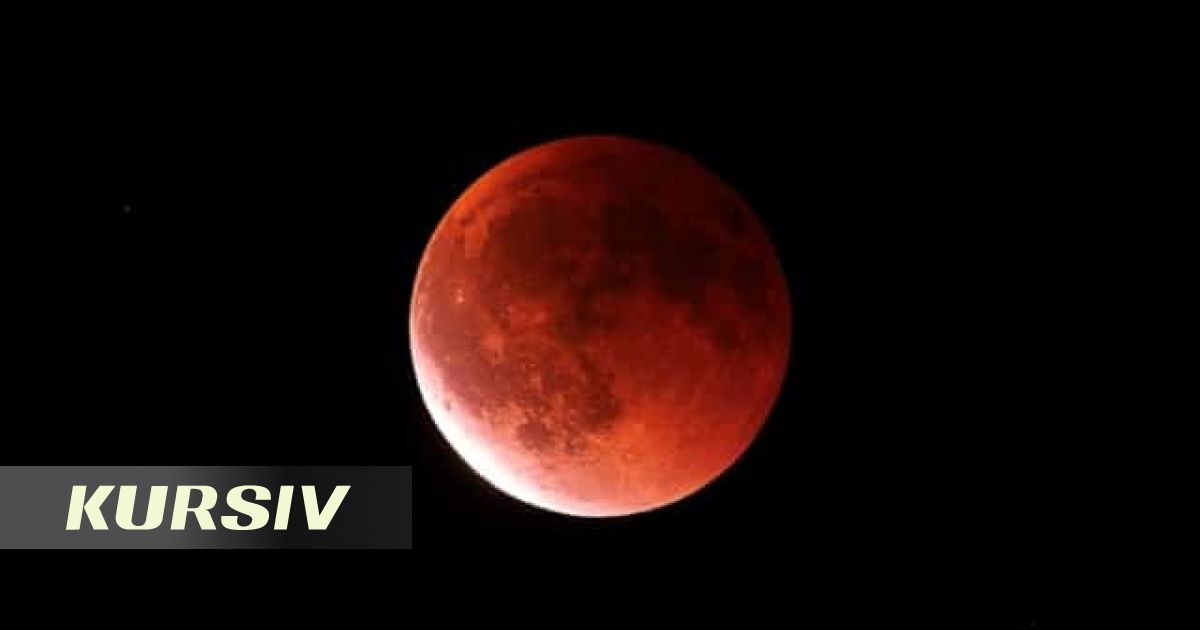
A deep partial lunar eclipse and the August full moon will occur almost simultaneously on August 28, 2026. This was reported by Qazaqyia.kz citing Kursiv Media.
At 9:18 local time, this will be the ninth full moon of the year, with the eclipse maximum expected at approximately 9:13 local time, just minutes before the exact full moon phase.
The lunar disk will plunge into Earth's shadow by almost 96%, becoming nearly a Blood Moon.
The almost round lunar disk can be observed not only at the exact moment of the full moon. However, to the human eye, the Moon appears full for about a day before and after the exact phase, so both the night of August 27-28 and the following evening are suitable for observation.
During a full moon, the Moon is on the opposite side of the sky from the Sun. Therefore, it rises around sunset, remains visible all night, and sets near sunrise.
The eclipse on August 28, 2026, will be especially spectacular because Earth's shadow will cover about 96% of the lunar disk. Near maximum phase, the shadowed part of the Moon may turn dark red or copper; only a small bright edge will remain outside the shadow.
The next lunar eclipses awaiting us in 2027 and 2028 will be penumbral or partial, but much less deep. They will not produce such an impressive effect. Only on December 31, 2028, will earthlings again see the Moon turn red.
The best region for observation is North and South America. In some parts of Europe and Asia, the eclipse will be partially visible: the Moon will appear low on the horizon, closer to moonset.
In Russia, the most impressive stage of the shadow phase will not be visible. Only in the westernmost regions of the country will it be possible to briefly observe the initial stages of the eclipse low on the horizon.
In Kazakhstan, conditions will be less favorable. The eclipse can only be observed in the far west of the country, primarily in the Mangystau, Atyrau, and West Kazakhstan regions, where part of the penumbral phase can be caught before moonset.
In Aktau, the penumbral phase will begin on August 28 at 6:23 local time. It can be observed until approximately 6:52, when the Moon sets. The noticeable partial phase will begin at 7:33, after moonset. Therefore, it is better to choose a location with a fully open horizon for observation.
In Atyrau, the penumbral phase can be observed until approximately 6:44, and in Uralsk until 6:39, when the Moon sets. In Aktobe and other regional centers of Kazakhstan, the Moon will set before the penumbral eclipse begins. The partial phase across the entire country will begin after moonset.
The coincidence of a lunar eclipse with a full moon is not accidental. A lunar eclipse is only possible during a full moon, when the Sun, Earth, and Moon align almost in a straight line, with Earth between the Sun and its satellite. At that moment, Earth's shadow can fall on the Moon and partially or completely darken it.
However, an eclipse does not occur at every full moon. The Moon's orbit is slightly inclined relative to the plane of Earth's orbit around the Sun, so most often during a full moon, the Moon passes above or below Earth's shadow. An eclipse occurs only when the full moon falls on a part of the orbit near one of its intersection points with the ecliptic plane — the so-called node.
This is exactly the situation that developed in August 2026. Two weeks before the lunar eclipse, on August 12, a solar eclipse occurred. Then the configuration was reversed: the Moon was between Earth and the Sun, covering the solar disk. After that, it continued its orbital motion and, in about half a lunar month, moved to the opposite side of Earth. By August 28, the full moon arrived, and now Earth was between the Sun and the Moon.
Therefore, solar and lunar eclipses often occur at intervals of about two weeks.
Earlier, Kursiv wrote about the total solar eclipse on August 12.