Miten Patel remembers the day hospital staff in Ahmedabad drew two vials of his blood to help identify his parents. A year ago, on 12 June, his parents Ashok and Shobhana Patel were flying home to London when their Air India flight crashed just 32 seconds after take-off from Ahmedabad. This was reported by Qazaqyia.kz citing BBC News.
The crash killed 241 people on board and 19 on the ground, making it one of the worst aviation accidents in India's history. One passenger miraculously survived. It took more than a week for the Patels' remains to be returned to the UK.
Four days later, Miten received a call from police in London. They asked to meet him that evening, refusing to tell him the reason over the phone. A CT scan had revealed that his mother's casket also contained the remains of someone else. Miten was told there were additional "skeletal parts". Police asked Miten not to tell anyone, not even his family, for weeks.
"I said to them, look, I would sincerely request that you separate my mother from whoever else," he said. Further testing showed that his mother's remains had been mixed with those of an unidentified man. The Patel family waited another month before they could cremate her remains, postponing Ashok's last rites so they could be done together.
A UK inquest has been opened into the death of the man in Shobhana Patel's casket, who still hasn't been identified. In a hearing this week, UK Coroner Fiona Wilcox said that they had "sent palm prints and DNA to India in an attempt to identify this gentleman but to date we have had no confirmation as to his name". She added that it was "obviously very unusual" to open inquests nearly a year after the death.
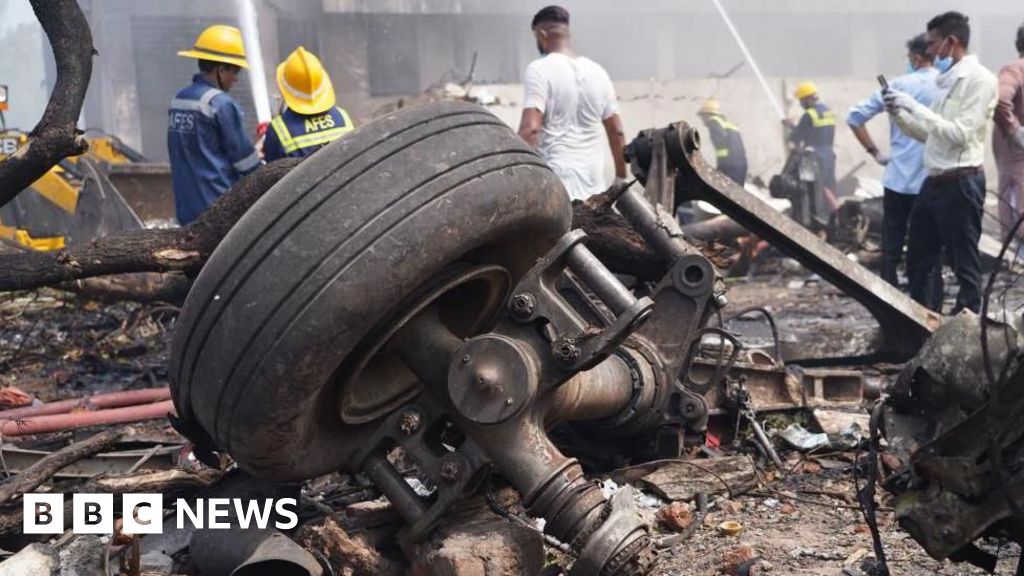
The challenge for emergency workers at the crash site was immense, with hundreds of casualties, and many bodies burned and torn apart. The wreckage was scattered across 37,000 sq m, the equivalent of five football pitches, as the plane collided with accommodation for medical students. One local resident who had rushed to help described struggling to pull out bodies from the debris, with seatbelts that were too hot to touch strapping the victims in.
An independent forensic expert deployed to identify victims of the crash, Dr Deepak Venkatesh, told the BBC that the scale of the disaster made identifying the victims even harder. The bodies of 90% of those killed were severely charred, and "extreme thermal damage destroyed fingerprints, facial features and other visual identifiers", according to India's National Disaster Management Authority (NDMA). The NDMA has since drawn lessons from the Air India crash and used it as a case study in new identification guidelines issued in January.
The BBC contacted the Indian foreign ministry, the hospital responsible for the identification process in Gujarat and the UK foreign office but has received no responses. In July last year, the Indian foreign ministry told the BBC that it had "been working closely with the UK side from the moment these concerns and issues were brought to our attention". The statement continued: "All mortal remains were handled with utmost professionalism and with due regard for the dignity of the deceased."
There is at least one other case in the UK where a family received the wrong remains. Amanda Donaghey returned to the UK believing she was carrying the remains of her son, 39-year-old Fiongal Greenlaw-Meek. She later discovered she had received the remains of 70-year-old Indian woman, Vasuben Narendrasinh Raj. This week, Wilcox, the UK coroner, said they had "only recently been able to make contact with the son of Ms Raj".