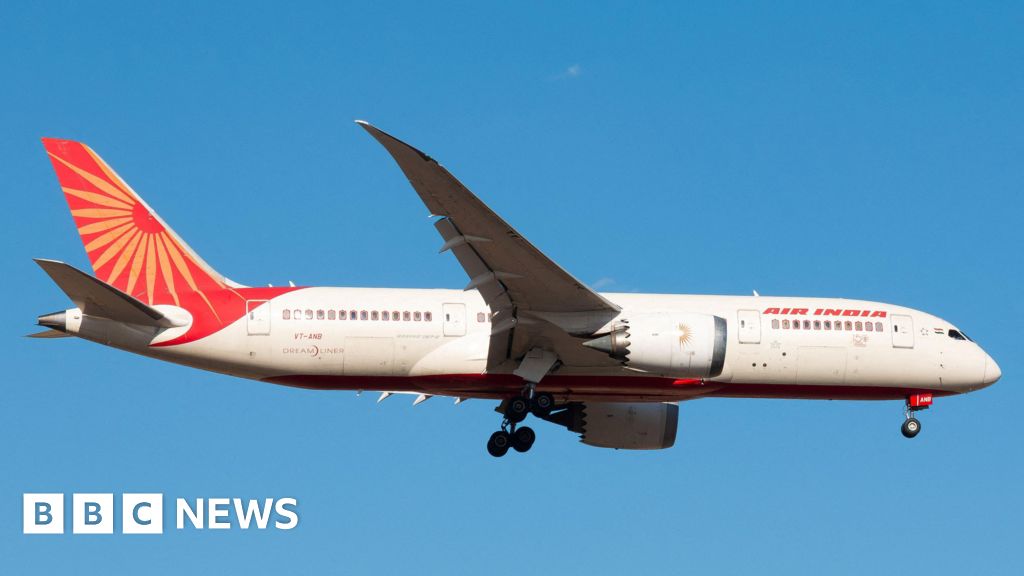
A year after Air India Flight 171 to London crashed into a medical college campus moments after take-off from the western Indian city of Ahmedabad, killing 260 people, investigators still cannot say with certainty why one of the world's most advanced passenger jets fell from the sky. This was reported by Qazaqyia.kz citing BBC News.
An update released by India's Aircraft Accident Investigation Bureau (AAIB) on the first anniversary of the disaster on Friday offered few new clues, saying only that analysis of flight recorder data, aircraft systems, engine components, maintenance records and human factors remains under way.
A preliminary report published last July found that seconds after take-off, the 12-year-old Boeing 787 Dreamliner's fuel-control switches abruptly moved to the "cut-off" position, starving both engines of fuel and triggering total power loss. Cockpit audio captured one pilot asking the other why he had done it, only to receive the reply: "I did not." Investigators did not identify either voice, though many experts saw the exchange as a possible indication of deliberate action in the cockpit.
While take-off and landing are aviation's riskiest phases, fatal accidents immediately after lift-off are uncommon. Boeing found that just 14% of global jet crashes between 2004 and 2013 occurred during take-off and initial climb; Airbus puts the figure at about 5%.
John Cox, a former airline pilot and aviation safety consultant, told the BBC that India's AAIB was entitled under International Civil Aviation Organization (ICAO) rules to take more time if necessary. "There is intense interest within India as to the cause," he said. "The insinuation that it was a deliberate act by the captain has drawn very strong criticism. The timing of the engine failure is key to determining the cause."
According to Shawn Pruchnicki, a former accident investigator and aviation expert at Ohio State University, the lack of answers after a year suggests investigators are still weighing multiple possibilities. "Air crash investigations are rarely straightforward," he told the BBC. "If investigators had already established a clear cause, the report would likely be out by now."
A veteran Canada-based air accident investigator, speaking anonymously to the BBC, said that final reports are sometimes delayed because their conclusions are "politically or institutionally sensitive". But he warned that "continued speculation about the cause risks muddying the waters further, making it harder for investigators to complete their work - and for the final report, whenever it arrives, to command public trust".
The preliminary report's finding that the fuel-control switches moved shortly before both engines lost power prompted speculation in parts of the foreign media that a pilot's actions lay at the heart of the disaster. That has triggered a backlash from pilots' groups, safety campaigners and lawyers for victims' families, who say the focus on the cockpit has raced ahead of the evidence.
Captain CS Randhawa, head of the Federation of Indian Pilots, argues investigators should pay closer attention to the aircraft's technical condition, including "encrypted health-monitoring messages [that routinely transmit data on engines, avionics and other critical systems] transmitted before and during the flight". The preliminary report, however, did not mention any such messages. "The preliminary report is incomplete and full of loopholes," Randhawa told the BBC.
According to the Canada-based investigator who didn't want to be named, the inquiry has become "unusually contentious because so many stakeholders have a vested interest in its outcome". "Families of the deceased pilots are defending their loved ones' reputations; pilot unions are resisting conclusions they believe unfairly implicate the crew; the airline is keen to demonstrate that safety and maintenance standards were sound; and the Indian authorities have a broader interest in preserving confidence in the country's aviation system."
At the heart of the AI171 mystery are two small cockpit fuel-control switches. These are no ordinary switches: they are physically latched, protected by locking mechanisms and designed to require deliberate action, precisely to prevent accidental engine shutdown. They are normally used before engine start, after landing or in serious emergencies - not seconds after take-off.
Cox says accidental switch movement is extraordinarily unlikely. After reviewing the histories of Boeing's 757, 767, 777, 787 and 737 Max fleets - more than 400 million flight hours - he found no case in which a switch failed.
The investigation continues, with answers still elusive.