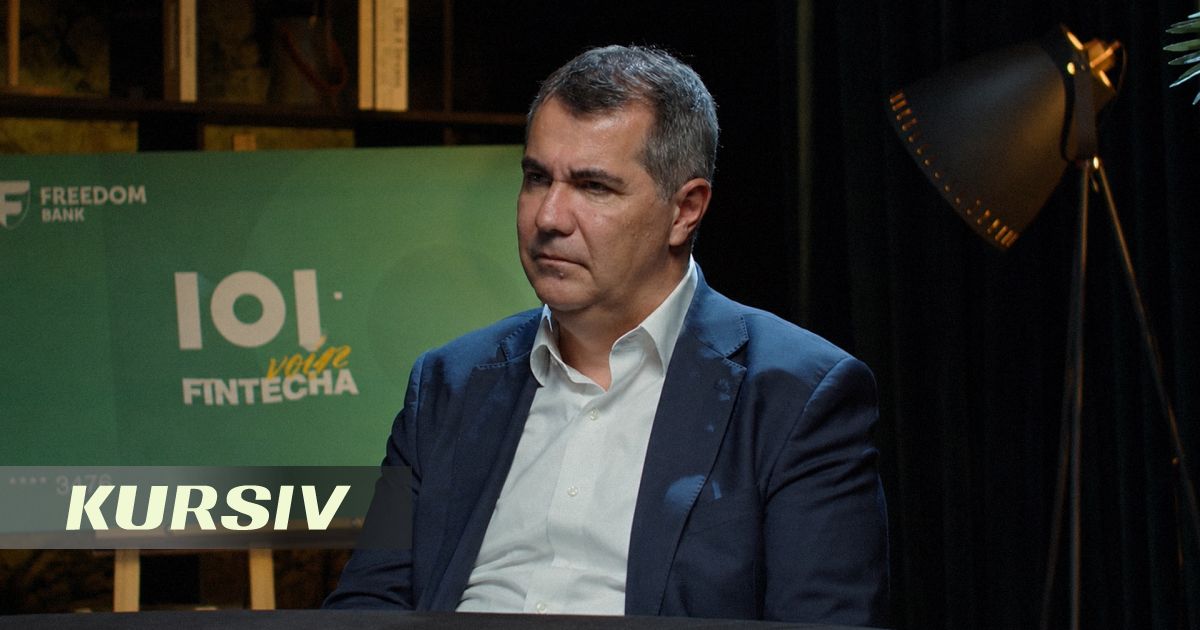
Air Astana CEO Ibrahim Zhanlyel believes the airline has prospects and will generate profit for its shareholders amid growth in passenger traffic and transit of foreign passengers. This was reported by Qazaqyia.kz citing Kursiv Media.
Air Astana's profit in 2025 fell by $35.9 million to $13.6 million, a decrease of 72.5%. In 2025, the company experienced 22 cases of Pratt & Whitney engine malfunctions, causing up to 13 aircraft to be grounded at the peak.
"We are satisfied with the IPO because it was very successful... now international investors understand that there is such an opportunity in Kazakhstan, in Central Asia for development... many international investment funds looked at the company and said, yes, there is a story there... they look at the prospect, and we are also confident in this prospect," he said in an interview with Ruslan Shayekin.
Air Astana ordinary shares were placed at 1,073.83 tenge per share during the IPO in early 2024, and global depositary receipts (GDRs) at $9.5 per share. After the IPO, the securities fell below the placement price and have not yet exceeded the initial level – as of today's trading on the Kazakhstan Stock Exchange (KASE), shares are worth 660 tenge (+0.31%).
Many minority shareholders who expected growth after the placement are forced to continue holding the securities for the third year in a row, while those who decided to exit recorded losses, losing faith in the airline. Nevertheless, the new head of the airline is confident that good times await it.
According to him, during the preparation for the IPO, he asked representatives of international investment funds what possible investment period in Air Astana shares they were considering, and they answered 5-10 years.
According to him, international investors also considered Kazakhstan's advantageous geographical location. The country is located in the center of Eurasia, just an hour and a half flight from China, and within a radius of several hours flight lives more than half of the world's population, making the airline based here attractive for developing international transportation.
"The price of the security (airline shares – Kursiv) is time (possibly meaning that the current low share price refers only to the present time – Kursiv). We cannot control that. But what can we control? This is the success of the company. And if we have plans for the future that we are confident will work and will bring profit for the airline, and develop more economy, more passengers. My personal opinion is that yes, there are very good opportunities (in the future of the airline – Kursiv)," he said.
In addition, Ibrahim Zhanlyel noted that he himself is a shareholder of Air Astana.
"I am also a shareholder of the airline. All 7,000 people in the company became shareholders after the IPO. Not only as a result of this, but we work and see that there is great potential both in Kazakhstan and in our region – in Central Asia and the Caucasus," he said.
The head of the airline said that in the 2000s, Air Astana started with a small fleet of three aircraft.
"We started with just $17 million, with which we bought 25% of one aircraft... Now we have 63 aircraft. There are another 65 aircraft on order for the future. This year, the (Boeing – Kursiv) 787 will arrive," he noted.
According to him, this year the airline expects to receive the first two Boeing 787s, with which the carrier hopes to start direct flights to New York (USA) in the coming year.
Many years ago, the first president of Kazakhstan, Nursultan Nazarbayev, instructed to connect the International Financial Center "Astana" with all major financial centers, including New York and Tokyo, by direct flights.
There was already a direct flight to Tokyo from Kazakhstan, but it was operated in 2019 from Nur-Sultan (now Astana) by SCAT airline, but the flight was discontinued due to low load.
Ibrahim Zhanlyel believes that one of the key difficulties in opening a direct flight to New York is the issue of ensuring service on the territory of the Russian Federation, through whose airspace the short route passes.
The fact is that Western countries have banned the supply of spare parts and service maintenance of Western-made aircraft to Russia. In this regard, the head of Air Astana did not rule out the possibility that if a Boeing 787 lands for any reason (refueling, need for maintenance, replacement of a part or device) in Russia, it could remain there for up to 10 years. Therefore, he expects that this issue will be resolved before the direct opening of the flight.
As for flights to Tokyo, the issue is the low percentage of visa approval for Kazakhstanis who want to visit Japan. This reduces demand from Kazakhstanis for flights to this country.
Ibrahim Zhanlyel noted that the airline is an ambassador of Kazakhstan abroad. According to him, there is great interest in visiting Kazakhstan among residents of the Middle East, for example, the UAE, Qatar, and so on. Residents of China and India are also interested in the opportunity to visit Kazakhstan. In addition, the airline can provide foreign passengers with the opportunity to transit through Kazakhstan to other locations. For example, residents of the Persian Gulf countries can fly through Kazakhstan to Japan and South Korea, and residents of Southeast Asia to the UK or Germany.
"In terms of transit potential, this year is very successful. In the first quarter, we developed transit passenger traffic by 65%, but in March it was 158% compared to last year," he said.
According to him, passengers from China, Thailand, India, or South Korea fly through Kazakhstan to Central Asia, the Caucasus, and Europe.
"From Shanghai, we have many tourists here who do a 2-3 day excursion in Almaty, then they fly to Uzbekistan or Georgia, or further. And also from Europe through Kazakhstan to the old Silk Road. And I think there is still very great potential for the future," he said.
The head of the airline noted that this summer, about 100 flights per week will be operated within Central Asia and the Caucasus.
"It turns out every day 14 flights between Kazakhstan and Uzbekistan, Kyrgyzstan," he said.