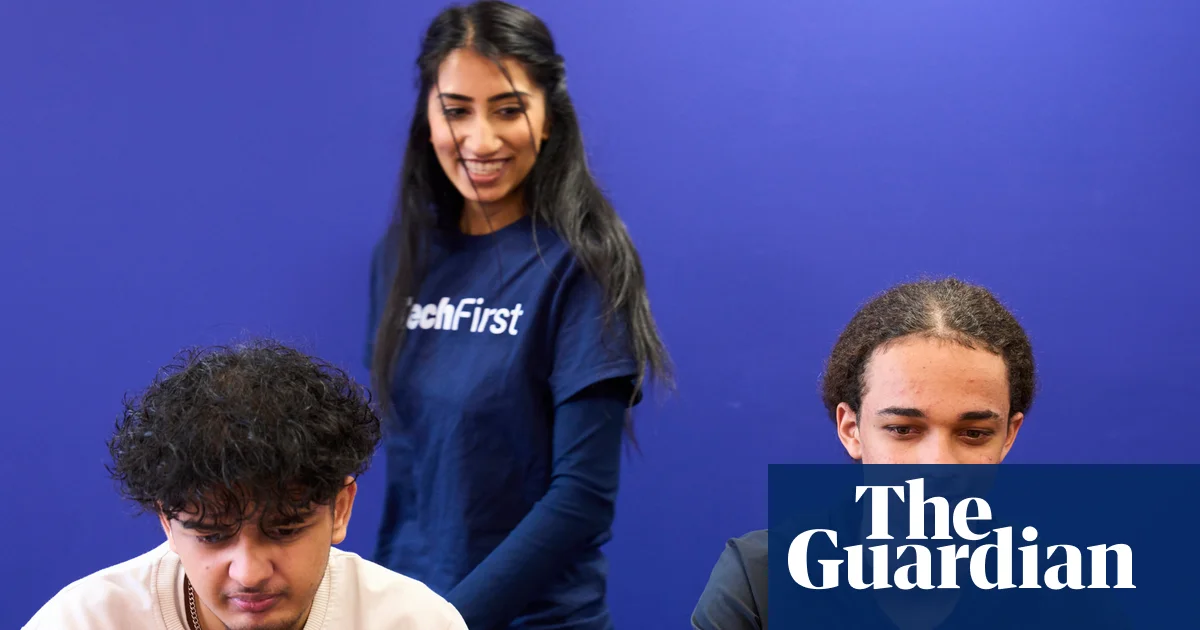
In a youth centre opposite Preston bus station, the UK government is trying to address two of the greatest challenges facing the national economy: AI and youth unemployment. This was reported by Qazaqyia.kz citing The Guardian.
The hope is that one will solve – rather than cause – the other. In a room at the recently opened Vault, a community hub in the Lancashire city, an "AI bootcamp" is under way – part of a trial in the north-west to give 16- to 24-year-olds AI training.
The bootcamp tutor is standing in front of a video screen and guiding the five attenders sitting around a long table on laptops through a task designed to emphasise the importance of glitch-free data in AI models.
"Does that make sense?" he asks. The room nods.
Everyone attending these sessions is either a 16- to 24-year-old not in education, employment or training – Neet, for short – or likely to join that bracket.
Youth unemployment is a problem in the UK. Nearly a million young people are Neet – just over one in 10 people in that age group. The advent of AI, either a threat or boon to the job market depending on your perspective, is now another factor to take into consideration when tackling the youth joblessness crisis.
Khudeija Rafique, who is attending the course, sees potential in the new tech. "It would be really helpful with whatever job I would like to go into," the 18-year-old from Burnley says.
These taxpayer-funded bootcamps are a pilot scheme, open to 70 people who will undergo a three-week programme specially designed for Neets to learn how to build AI tools, understand how businesses use AI, and learn to use the technology responsibly. The retailer JD Sports, food company Heinz and IT firm Agilysys are among the partners offering AI apprenticeships specifically designed for the attenders to join at the end of the course.
There are two types of apprenticeship available: one for aspiring content creators to become AI marketing specialists, another to join IT helpdesks that need AI expertise. If a boot-camp trainee gets an apprenticeship, they will be going to an organisation that wants these skills and has an AI-focused role to fill.
"This is an opportunity to bridge a gap, to improve productivity and bring AI into organisations," says Lauren Monks, an executive at IN4 Group, the company contracted to run the programme.
Amid general concerns about the availability of entry-level jobs and whether AI is stifling that market, being on top of the technology can be an advantage if you're seeking your first job.
This is common advice from graduate recruiters, but experts say it can apply to Neets as well, depending on what sector of the economy they are joining.
Remy Simms, 17, is interested in applying for the content creator apprenticeship and says the Preston course has "changed my opinion" on AI. "It shows that you can work with AI and you don't have to work against it," he says. "I've got a better understanding of it and I know more about how it works."
Alan Milburn, a former Labour cabinet minister, warned in a recent report that the country was "at risk of a lost generation" without government action on the Neet crisis. Milburn's prescription goes a lot further than AI bootcamps – he calls for reform of the welfare system, for instance – and his report points out that work programmes by successive governments have failed to answer the problem.
Concerns about AI's impact on employment have focused on the graduate job market so far, not on school leavers and non-graduates, amid expectations that it will be able to do the "grunt work" associated with junior employees in areas such as banking, consulting and law.
The impact on non-graduate work was unclear, according to Dr Bouke Klein Teeselink, who is researching AI and the future of work at King's College London.
"We don't have really good insights into how AI affects the non-graduate market compared to the graduate market," he says, but suggests this scheme could help answer the puzzle of getting more young people into the labour market.
The key test of the bootcamps and ensuing apprenticeships, Teeselink says, would be the thoroughness of the AI training and whether these newcomers made a real difference to their employers' productivity. "I hope the policy will be rolled out in a way that allows the government to answer both those questions," he says.
Hamid Muhammad-Asif, 16, says he would be happy with a content creator or IT helpdesk apprenticeship.
So will the bootcamps make a difference to Neet numbers? Experts say there is no single cause of the crisis and any comprehensive measures are needed.