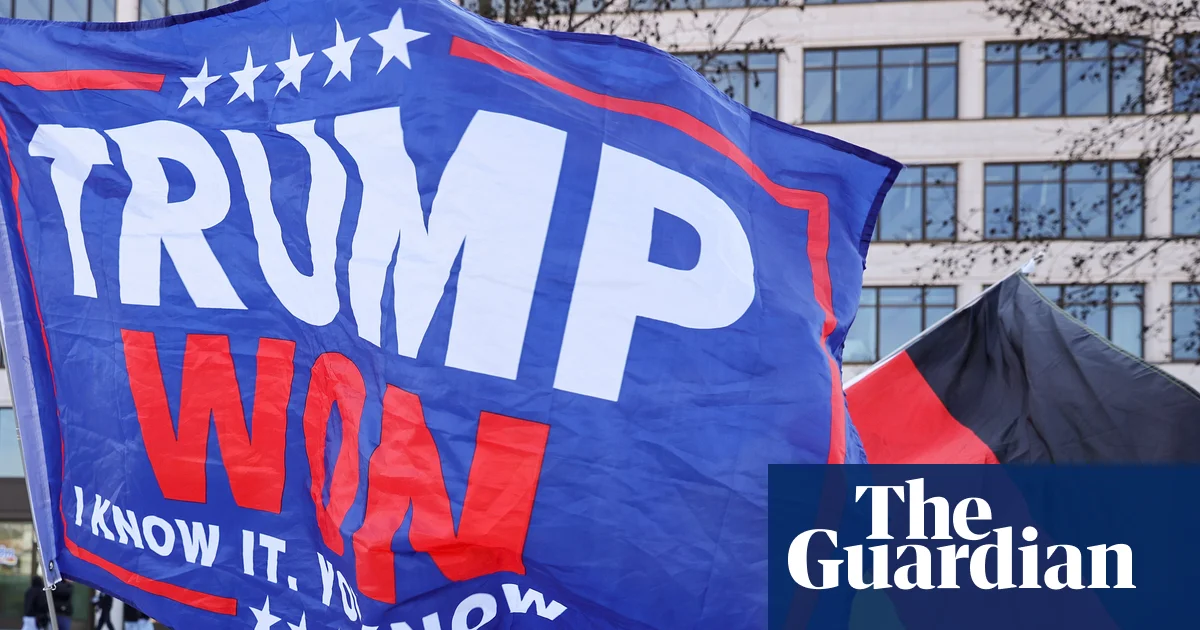
A data leak from Germany's far-right Alternative für Deutschland (AfD) party has revealed the extent of its efforts to court Donald Trump and other leading figures in the Maga movement, stretching back more than a decade. This was reported by Qazaqyia.kz citing The Guardian.
The trove reveals the pains the AfD took in wooing the president, whom they saw from the beginning as a potential ally, with senior party officials agonising over the wording of an obsequious congratulatory telegram when he was elected in 2016, which included the wish that his "hopes as a person be fulfilled".
The AfD became a home for anti-immigration voters after 1.2 million refugees arrived in Germany in 2015 and 2016. It entered the Bundestag, Germany's parliament, in 2017 with 12.6% of the vote, came second in the February 2025 federal election with 20.8%, and now leads national polls at about 30%. In September it won 43.8% of the vote in the eastern state of Saxony-Anhalt, and it is now trying to form Germany's first far-right state government since the second world war.
Trump hailed the win in Saxony-Anhalt in a post on his Truth Social, concluding his message with a German version of his Make America Great Again acronym, "MGGA!!!"
Germany's domestic intelligence agency monitors the party as a suspected rightwing extremist organisation, and state agencies classify five of its regional branches as confirmed extremist.
Its leader in the central Thuringia region, Björn Höcke, was convicted in 2024 of knowingly using a slogan of the SA, the Nazi party's paramilitary wing. AfD politicians also attended a meeting with extremists at which a mass-deportation "masterplan" was discussed. Its 2025 election programme calls for lifting sanctions on Russia and repairing the Nord Stream gas pipelines programme. Nearly all of Germany's other parties have kept a "firewall", refusing to govern with it.
Media outlets including the Guardian have reported on the apparently friendly contacts between the party and the US state department during Trump's second term.
The leaked documents show AfD officials quickly moving to requests for support from the White House on policy issues when he first won the 2016 election. Others show a burgeoning political courtship between senior figures including the AfD's now leader Alice Weidel and key Trump ideologue Steve Bannon.
The data, provided to reporters by the transparency organisation Distributed Denial of Secrets (DDoSecrets), covers more than 420,000 emails, along with documents and personnel records, from the party's foundation in 2013 to the present, with most coming before 2019.
The AfD said in a statement on Monday that a hosting provider used by the party had been attacked at the end of September and that "only a few mailboxes" had been copied. It told the news agency dpa that most of those mailboxes had not been used for years, and party sources were quoted as saying the published material appeared to be authentic.
AfD figures praised Trump ahead of his first election in 2016, with then leader Frauke Petry calling him a "refreshingly alternative proposition" in the spring of 2016. On the day after Trump won the presidency, Petry said the victory was "encouraging for Germany and for Europe".
The hacked documents reveal that in the wake of his election, the party scrambled to send an ingratiating telegram to the new president.
Mainstream German politicians greeted Trump's election with skepticism. On 9 November 2016, then chancellor Angela Merkel offered Trump "close cooperation" only "on the basis of … values" including respect for human dignity "regardless of origin, skin colour, religion, gender, sexual orientation or political views". The then defence minister Ursula von der Leyen called the result a "huge shock". The next day the vice-chancellor, Sigmar Gabriel, reportedly called Trump the "forerunner of a new authoritarian and chauvinist international", and he counted the AfD among its forces.
On 10 November, Petry emailed the party's federal board proposing "an official and brief congratulatory telegram to the future US president". German politics, she wrote, was "once again outdoing itself in politically unacceptable behaviour"; the AfD was "already perceived as the ones who don't join in the majority howl of the political establishment" and, "as the only German party welcoming a new beginning in the US", should say so officially.
Eleven of the board's 13 members replied, all in favour. Current leader Weidel wrote "Yes:-)". Beatrix von Storch, now deputy leader of the party's Bundestag group, wrote: "Couldn't be more of a yes."
Board member Dirk Driesang added that Trump should also receive, "by post (?)", the party's manifesto in English.
The telegram went out on 11 November under Petry's name, "on behalf of the federal board", and was released to the press. It told the president-elect: "We are confident that you will readjust the transatlantic relationship and end the wars in Syria and Ukraine by mutual agreement with Russia."
A second message, for the inauguration, was planned more carefully, and included a concrete request for a political favor. On 11 January 2017,...