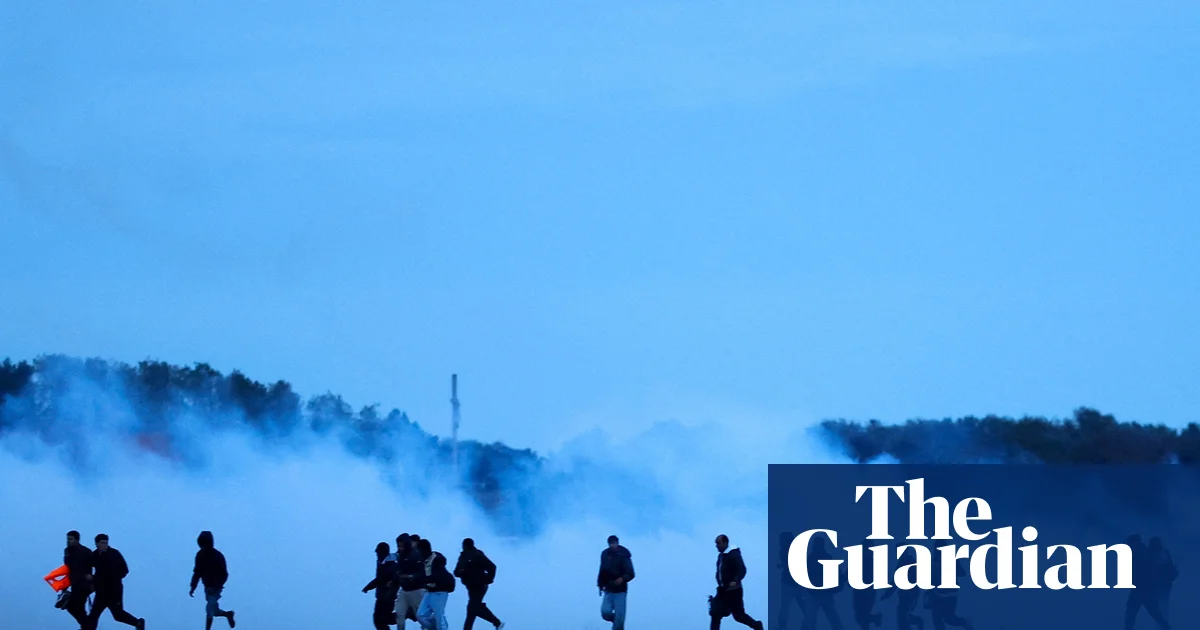
People run away from teargas fired by police as they try to cross the Channel from Petit-Fort-Philippe in Gravelines, near Calais. Photograph: Hannah McKay/Reuters This was reported by Qazaqyia.kz citing The Guardian.
The smuggler works quickly. Using a small shovel, he digs up a dinghy buried in a sand dune on a beach not far from Boulogne-sur-Mer, assembles it and affixes a motor in record time.
"I never saw anyone work like this," says Amad, from Iraq, one of a group of about 30 asylum seekers waiting to cross the Channel. "The UK government wants to stop the smugglers, but they are smart. They have plan A, plan B and plan C, so there is always a way for them to get people across this sea. For as long as asylum seekers will pay them, there is too much money involved for them to give up."
The wind has dropped, the waves are flat and there are no French police in sight. The conditions are perfect as the smuggler rushes everyone into the dinghy as it moves away from the shore.
Amad is one of several asylum seekers who spoke to the Guardian this week from the area of northern France known as the Jungle. They were hoping to cross the Channel to the UK in the next few days.
"This place is busier than ever," says another asylum seeker, Omar, from Yemen. "So many refugees and so many smugglers are here. Everyone wants to cross."
Police officers stand guard on the beach in Petit-Fort-Philippe, Gravelines, near Calais. Photograph: Hannah McKay/Reuters
Some who have already been forcibly removed from the UK are hoping to return. They were sent to France under the "one in, one out" scheme, where one small-boat arrival is forcibly returned to France in exchange for another asylum seeker brought legally to the UK.
Now, after moving approximately 1,500 people in both directions across the Channel, the scheme has been brought to an end. Beset with problems, it could not be effectively scaled up, the British government concluded.
NGOs working on the ground with asylum seekers in northern France were unsurprised by the outcome and say the end of "one in, one out" must prompt a wider discussion about how to deal with the crisis in the Channel.
The UK government has shown little sign it is contemplating a radical shift in attitude. A Home Office spokesperson pointed the Guardian to an announcement about a refugee resettlement scheme that is likely to assist only a few hundred refugees a year and is highly unlikely to stop people crossing the Channel in small boats.
The spokesperson said: "Just last week, the home secretary announced the reopening of the UK resettlement scheme for new referrals, providing genuine refugees with a safe and legal route to the UK."
The agencies calling for a different approach hope at least to expand the parameters of the debate.
People sit inside a bus at the port of Calais after three people including a child died while attempting to cross the Channel on 28 September. Photograph: Hannah McKay/Reuters
According to workers in the Jungle, living conditions there are appalling. Those at Utopia 56, which witnesses police interventions on French beaches where asylum seekers try to board dinghies, say that since the UK increased its funding to France earlier this year on a payment-by-results basis, police violence against migrants has increased significantly.
Utopia 56 estimates a 40% increase in police violence from April to August 2026 compared with the same period the previous year. That coincided with an agreement for the UK to pay France £660m over three years to ramp up "stop the boats" initiatives.
Sophie McCann, of Médecins Sans Frontières UK, said: "The government's increasingly brutal efforts to stop people trying to reach the UK by boat are failing. MSF's medical and mental health teams in Calais and Dunkirk witness the serious physical and psychological harm caused by violence and harassment meted out by French police, largely funded by the UK, on people who have already fled war, persecution and extreme hardship.
"People will continue to risk their lives crossing the Channel in search of safety in the UK until the government provides safe and accessible routes."
The Public and Commercial Services (PCS) union, which has many Home Office staff among its members, has worked with the refugee charity Care4Calais to draw up a blueprint to introduce a refugee visa-to-travel scheme for asylum seekers to travel legally to the UK.
The plan would still require asylum claims to be considered on merit and for those whose claims are rejected to be removed from the UK. But they say it would eliminate people smugglers from the equation and save lives. According to the UN's International Organization for Migration (IOM), at least 225 people have died while trying to cross the Channel since 2018.
People gather after disembarking from a French rescue ship after their boat was caught in the Channel at Boulogne-sur-Mer on 4 August. Photograph: Sameer Al-Doumy/AFP/Getty
The scheme would be unlikely to halt irregular arrivals entirely, but Care4Calais says it could dent the smugglers' business in a way that other initiatives have failed to do.
Free newsletter | Weekly
Sign up to This is Europe
The most pressing stories and debates for Europeans – from identity to economics to the environment
Charlotte Khan, of Care4Calais, said: "Consecutive governments have focused on border security measures that have only made Channel crossings harder."