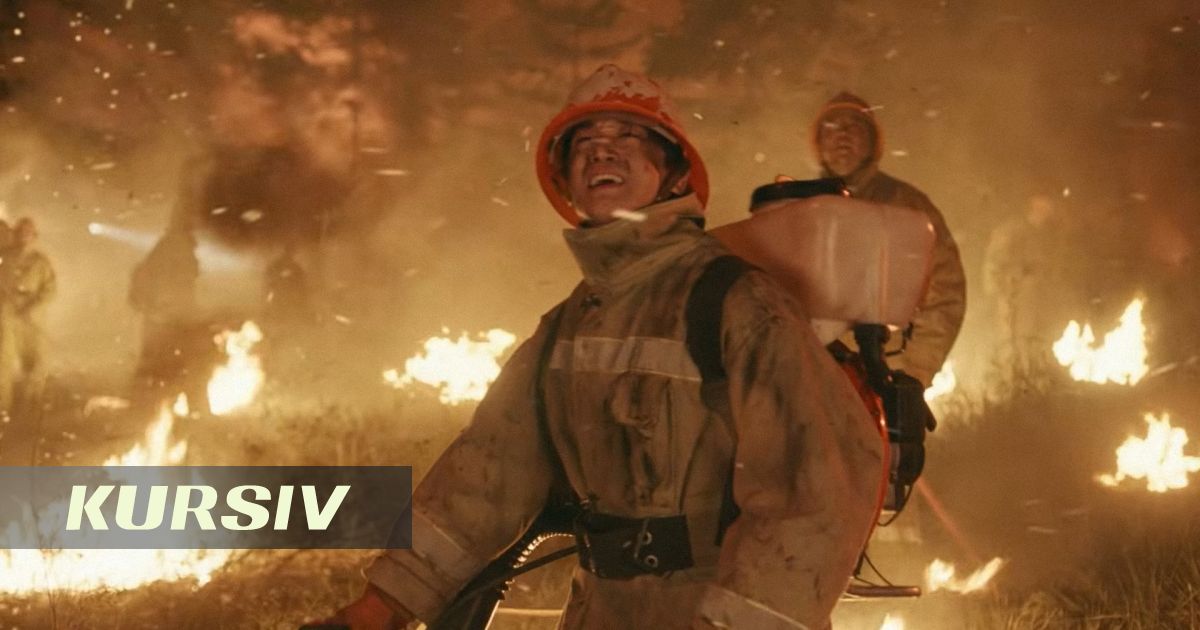
September, which is very fruitful for Kazakh cinema (as many as 12 domestic films are expected!), began with a weekend where the most intriguing premiere was the action-drama based on real events, “38. Sońǵy núkte”. This was reported by Qazaqyia.kz citing Kursiv Media.
The film is dedicated to the largest forest fires in the country's history, which occurred in the summer of 2023 in the Abai region. According to the review's authors, it turned out to be truly spectacular, but very superficial and with big questions about the content.
Background
On June 8, 2023, in the “Semey Ormany” reserve, according to the official version, due to lightning discharges amid dry and hot weather, a fire broke out, growing from 0.3 hectares to 60 thousand hectares at its peak. During the fight against it, 14 forestry workers and one local resident died. It was only possible to finally cope with the fire after several weeks, then there were investigations, trials, and prison sentences.
About the Film
Three years later, the film “38. Sońǵy núkte” was released, made by order of the Ministry of Culture and Information with the support of the State Center for Support of National Cinema and the Ministry of Ecology and Natural Resources. Its budget, according to the author, was no more than 300 million tenge, which is not very much these days – especially for a large-scale picture.
According to the plot, in the Abai region, a gang of illegal loggers operates, led by the textured Yerkin (Maksat Sabitov). They cut and export pines at night. At site number 38, partners Marat (Asan Mazhit) and Gani (Arman Uakhitov) work, trying to catch the criminals. It is on their territory that the largest amount of forest disappears. Suddenly, lightning strikes a pine tree.
Reviewers' Opinions
The runtime of “38. Sońǵy núkte” is only about 80 minutes. With such a time limit, it is a priori difficult to make a large-scale, at least somewhat deep dramatic picture, especially if accompanied by action. The authors never figured out what to choose.
The main characters were given at least some traits and motivation (an incurable disease and gambling addiction), but other characters turned out even “thinner”. The villain is ominous, his boss is even more ominous (an unexpected appearance by Altynay Nogerbek in an unusual role).
In its action part, the film looks spectacular. We must give credit to the group led by director Torebek Beisebaev and cameraman Asylkhan Meldebekov. The music by composer Abai Akbaev works well.
Criticism
The review authors note many questions. For example, the economics of illegal logging is doubtful: a shawarma stand would be a more profitable and safer business. Also surprising is the hyper-fixation on smoking: almost all characters smoke on screen. Some editing decisions add effect: a policeman lights a thick cigarette at the scene, and in the next frame lights a thin one in his office.
The film's main innovation: the main character is forced to miss almost the entire climax and does not participate in the development of events. However, these scenes turned out to be truly tense.
Conclusion
The authors advise: if you are going to watch the film, leave the hall at the scene where Asan Mazhit beats his fists on the mud in the forest, because after that a pompous officialdom begins. The question arises: did we watch a film “based on” or close to reality? It is impossible to harmoniously combine both.