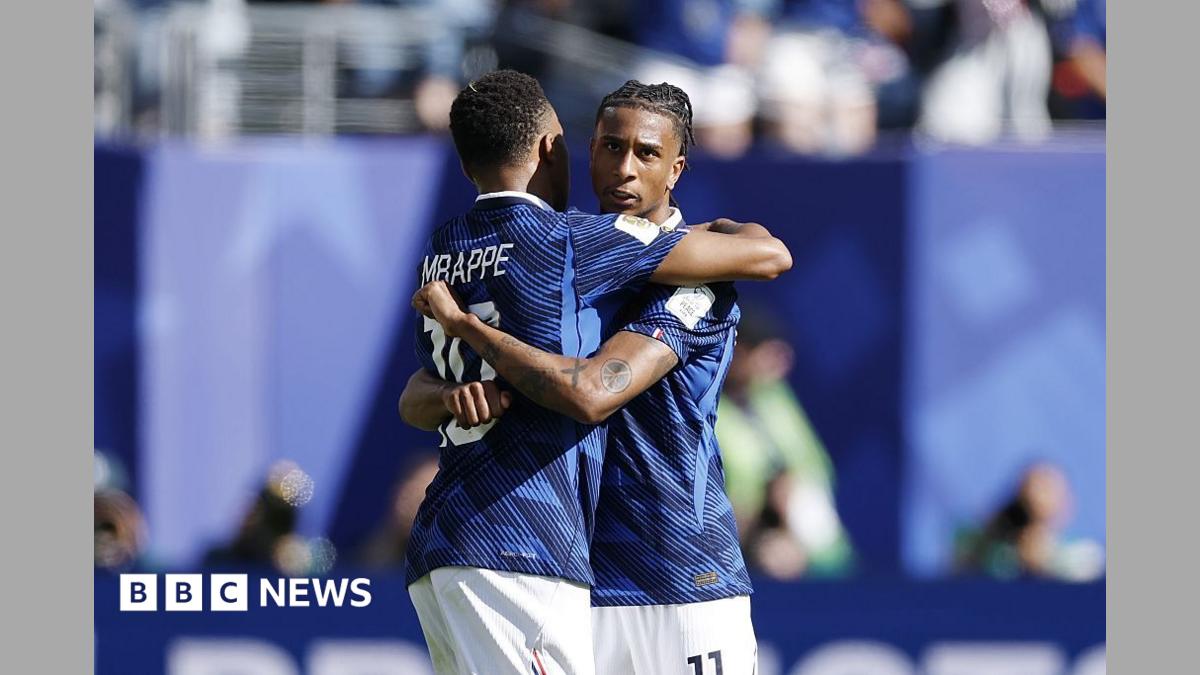
Nearly a quarter of players at the 2026 FIFA Men's World Cup represent countries other than their birth nation, the highest proportion ever. This was reported by Qazaqyia.kz citing BBC News.
On 13 June, Morocco made World Cup history during their 1-1 draw with Brazil — not one of their players on the pitch had been born in Morocco.
The tournament has already seen a player score against his birth nation: France-born Ibrahim Mbaye netted for Senegal in their 3-1 defeat to Les Bleus on 16 June. In 2022, Switzerland attacker Breel Embolo, born in Cameroon, became the first player in the tournament's more than 90-year history to score against his own birth nation. He did not celebrate, lifting his hands in an apologetic gesture. "I knew that if I scored I wouldn't celebrate the goal, out of respect. That didn't mean to say I wasn't happy about it, though," Embolo told reporters.
In the 2026 World Cup, only eight out of 48 teams do not have a player born abroad. Debutants Curacao feature only a single player born on the Caribbean island. Qatar has brought players from 10 nationalities.
A high-profile case is Michael Olise. Born and bred in London, the Bayern Munich winger has chosen to represent France, his mother's birth country. Antonee Robinson, born in Milton Keynes, England, qualifies for the US team through his father.
Such switches have created family divisions. Four sets of brothers are representing different teams: Desire and Guela Doue (France and Ivory Coast), Nico and Inaki Williams (Spain and Ghana), Harry and John Souttar (Australia and Scotland), and half brothers Derrick Luckassen and Brian Brobbey (Ghana and Netherlands). Before 2026, this had happened only twice — when half brothers Jerome and Kevin Prince Boateng played in two World Cups (2010 and 2014) representing Germany and Ghana.
Professor Gijsbert Oonk, a Dutch historian at Erasmus University, says the trend reflects a changing world. "Almost 4% of the world population lives in a country in which they were not born. This is even higher with high-skilled workers and elite athletes," he explains.
According to Oxford University's COMPAS research, the proportion of foreign-born players stayed between 2% and 14% until the last two tournaments. It reached 16.5% in Qatar in 2022 and rose to more than 23% in 2026 — 289 out of 1,248 players.
FIFA was created in 1904 but only established formal nationality rules in the 1960s. Until then, players could play for any country. The most prominent example is Luis Monti, who represented Argentina in 1930 and then Italy in 1934, winning the trophy. He remains the only person to have played in World Cup finals for two different nations.
In 1962, FIFA issued eligibility criteria requiring citizenship. In 2004, FIFA allowed players to represent one country at youth level and switch at senior level, but stipulated a "clear connection" — at least one parent or grandparent born in the country, or residence for at least two years.